
What Is the Environmental Sustainability Grid?
The environmental sustainability grid is a simple 2×2 tool for mapping what a business does about the environment. It was developed by Hart and Milstein (2003), who argued that most managers treat sustainability as a “one-dimensional nuisance” of regulations, added cost and liability. They argued it should be treated as a source of value instead. The grid is now a standard part of how sustainable marketing is taught (Kotler, Armstrong and Opresnik, 2018).
The grid has two dimensions. The first is time: is the activity about today’s business or tomorrow’s? The second is focus: does it happen inside the firm (its own operations and skills) or outside it (customers, suppliers, communities and wider society)? Combining the two produces four strategies, and each creates a different kind of value.
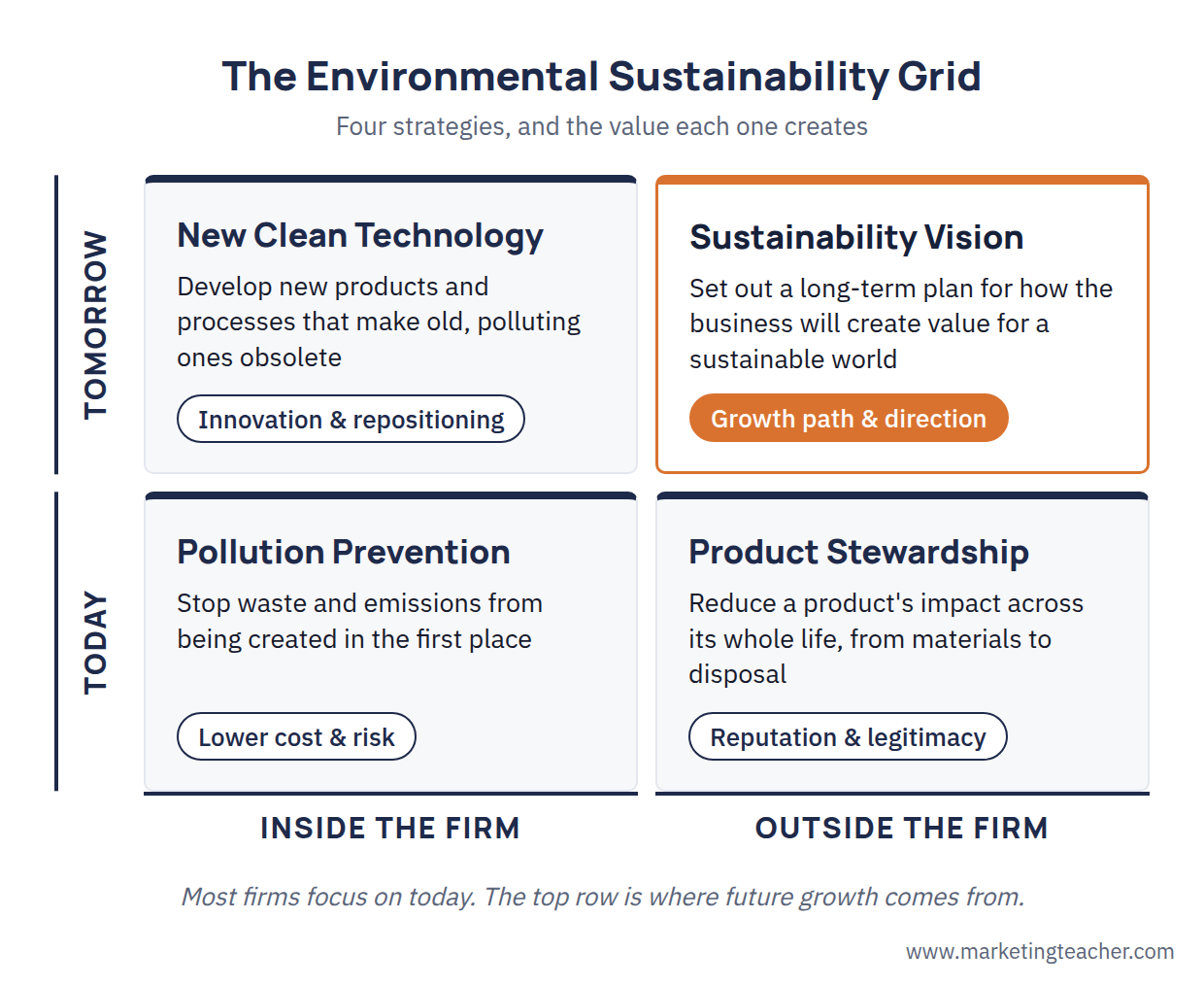
1. Pollution Prevention (Today, Inside the Firm)
Pollution prevention means stopping waste and emissions before they are created, rather than cleaning up afterwards. It usually pays for itself because less waste means lower costs and lower risk. UK cosmetics retailer Lush is a well-known example. Its “naked” products, such as solid shampoo bars, are designed so that no packaging is needed at all. Lush launched 186 new naked products in its 2025 financial year, and it estimates that one shampoo bar replaces around three 200ml bottles of liquid shampoo.
2. Product Stewardship (Today, Outside the Firm)
Product stewardship widens the view from the factory to the product’s whole life: the materials it is made from, how it is used, and what happens when it is thrown away. Because this is visible to customers, campaigners and regulators, the main reward is reputation and legitimacy. Apple is a strong current example. Its 2026 environmental progress report says that 30% of the material in products it shipped in 2025 came from recycled sources. It also reports 100% recycled cobalt in all Apple-designed batteries and a completed move to fibre-based, plastic-free packaging.
3. New Clean Technology (Tomorrow, Inside the Firm)
New clean technology looks beyond improving today’s products and asks which new capabilities would make them obsolete. The value here is innovation and the chance to reposition the business before competitors do. London start-up Notpla, which won the £1 million Earthshot Prize in 2022, makes packaging from seaweed and plants instead of plastic. Its food containers are used at stadiums such as Twickenham and Tottenham Hotspur, and by takeaway platform Just Eat. Notpla reports that it had replaced more than 21 million units of single-use plastic by 2025, and it aims for one billion by 2030.
4. Sustainability Vision (Tomorrow, Outside the Firm)
A sustainability vision is a long-term plan for how the business will meet society’s future needs. It acts as a road map that guides the other three strategies. Outdoor clothing brand Patagonia made one of the boldest recent statements of vision. In 2022 its founder transferred ownership of the company to a trust and a non-profit collective, and announced that “Earth is now our only shareholder.” Profits not reinvested in the business, which Patagonia estimated at about $100 million a year, now go to fighting climate change and protecting nature.
• Product stewardship: switching to certified beans and printing compostable-cup disposal instructions.
• New clean technology: nothing yet.
• Sustainability vision: nothing yet.
Why Balance Matters
Hart and Milstein (2003) argued that most firms concentrate on the bottom half of the grid, because pollution prevention and product stewardship deliver quick, visible results. A firm that stays there risks being overtaken when technology or regulation changes. A firm that only has a vision risks being dismissed as greenwashing (see sustainability and marketing), because it has no practical action to back its claims up. The strongest positions cover all four quadrants.
The research gives this a note of caution. Reviewing fifteen years of studies, Hart and Dowell (2011) found strong evidence that pollution prevention improves profitability, but much weaker evidence for the other three strategies, mainly because researchers have studied them far less. So the grid is best seen as a planning and auditing tool rather than a proven formula for profit. It works well alongside wider frameworks such as the triple bottom line (see ethics, sustainability and strategy) and the idea of sustainability as a core brand value.
Summary
The environmental sustainability grid sorts a company’s environmental activities by time (today or tomorrow) and focus (inside or outside the firm). This gives four strategies: pollution prevention, product stewardship, new clean technology and sustainability vision. Lush, Apple, Notpla and Patagonia each illustrate one quadrant. The grid’s main use for marketers is as an audit: it quickly shows whether a business is only tidying up its present or also building its future. A useful next step is to consider how these strategies fit into your wider PESTEL analysis of environmental and legal change.
The slides, worksheet, lesson plan and poster for this lesson are free to download and free to use in your course — no sign-up, no permission needed. See the teacher resources →
Assign this lesson to your class:
Using Canvas, Blackboard or Moodle? Copy the link and paste it into your course page or assignment. More ways to add lessons to your LMS.

