
What Is “Process” in the Marketing Mix?
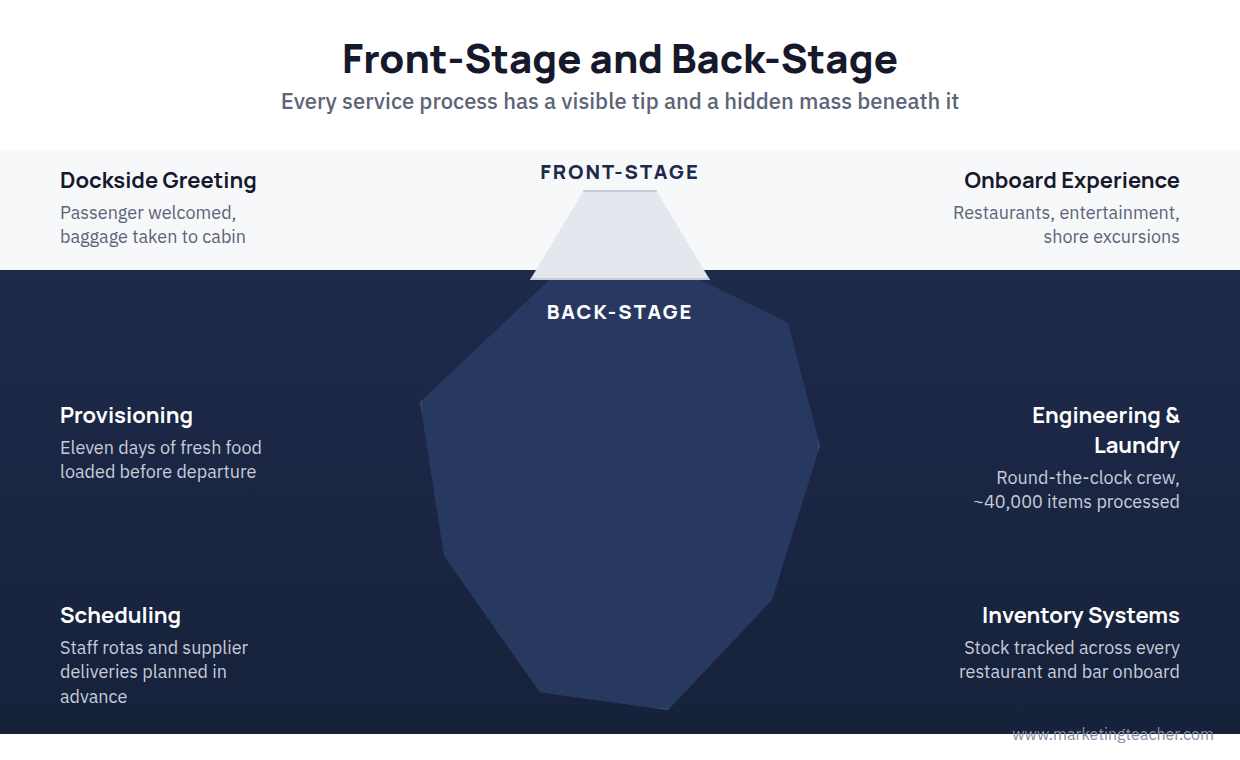
Booms and Bitner (1981) added process, alongside people and physical evidence, to the traditional four-element marketing mix specifically to cover services, and process is arguably the least visible of the three. It refers to the actual procedures, mechanisms and flow of activities by which a service is created and delivered to the customer, rather than any single physical thing changing hands. Shostack (1984) made the case that this matters because a service, unlike a manufactured product, unfolds over time as a sequence of steps a customer moves through, and that sequence can be deliberately designed, documented and improved, in much the same way a factory line can, even though nothing about it is physically visible on a shelf.
Front-Stage and Back-Stage: What the Customer Sees, and What They Don’t
Shostack (1984) drew a distinction that has shaped how services are designed ever since: front-stage activities are the direct, visible steps a customer actually experiences, while back-stage activities are the indirect, invisible work that supports the service before, during and after that visible moment. A restaurant’s front-stage process is being greeted, seated, served and billed; its back-stage process is the kitchen prep, supplier deliveries, inventory management and staff scheduling the customer never sees but that make the front-stage moment possible at all. A business can have excellent back-stage systems and still fail if the front-stage sequence is confusing or slow, and the reverse is just as true: a beautifully designed front-stage experience will eventually break down if the back-stage support behind it is unreliable.
Technological, Electronic and Integrated Processes
Not every process looks the same. Technological processes cover the manufacturing or adaptation of a product to an individual customer’s requirements, such as a car maker building each vehicle on its production line to match one buyer’s chosen specification. Electronic processes include systems like electronic point-of-sale terminals, barcodes scanned at a till or by a smartphone, and loyalty cards, all of which speed up and standardise a transaction while also capturing data the business can use later. A further, broader view treats an organisation’s separate processes as pieces that need to integrate with one another, so that a customer’s experience of, say, a company’s website and its call centre feels like one consistent process rather than two disconnected systems that happen to share a logo. A customer who has to repeat the same information to a website chatbot and then again to a phone agent is experiencing a process failure, even if each individual system works perfectly on its own, which is exactly the kind of gap integrated process design is meant to close.
Why the Sequence of a Process Shapes the Experience
Every process has inputs, throughput and an output, and value chain analysis is one established way of examining how value is added at each of those stages. For a service business, process design also has to allow for the fact that many customers experience broadly the same service at the same time, so a process built for one customer at a time rarely scales, and a well-designed process usually needs to flex enough to feel personal to each customer while still being repeatable for the next thousand who go through it. Feedback loops matter here too: a business that only measures outcomes at the very end of a process, rather than checking in at intermediate stages, tends to discover a problem only once it has already affected a large number of customers rather than just the first few.
Summary
Process is the sequence of activities, both front-stage and back-stage, through which a service is actually delivered (Booms & Bitner, 1981; Shostack, 1984). Front-stage steps are what a customer experiences directly, while back-stage activities, from provisioning to scheduling, support that experience without ever being seen. Technological and electronic processes standardise and speed up delivery, but the sequence still has to be designed deliberately, tested for where it breaks down, and revisited as feedback comes in, since a weak link anywhere in the process is usually what a customer remembers, however strong the rest of the service was. Process works alongside people and physical evidence to complete the extended marketing mix for services.
The slides, worksheet, lesson plan and poster for this lesson are free to download and free to use in your course — no sign-up, no permission needed. See the teacher resources →
Assign this lesson to your class:
Using Canvas, Blackboard or Moodle? Copy the link and paste it into your course page or assignment. More ways to add lessons to your LMS.

