
What Is “Place” in the Marketing Mix?
Place is the marketing mix element concerned with getting a product or service from the business that makes it to the customer who buys it. Kotler and Armstrong (2018) define a marketing channel as a set of interdependent organisations that work together to make a product or service available for use or consumption by a customer or business user. Very few producers sell directly to the person who eventually consumes their product; most rely on a chain of other organisations, known as intermediaries, to move goods from the factory floor to the point of sale. Place is also commonly called distribution or channel, and the decisions a business makes here shape how easily, and at what cost, its target customers can actually get hold of what it sells.
Direct, Short and Long Distribution Channels
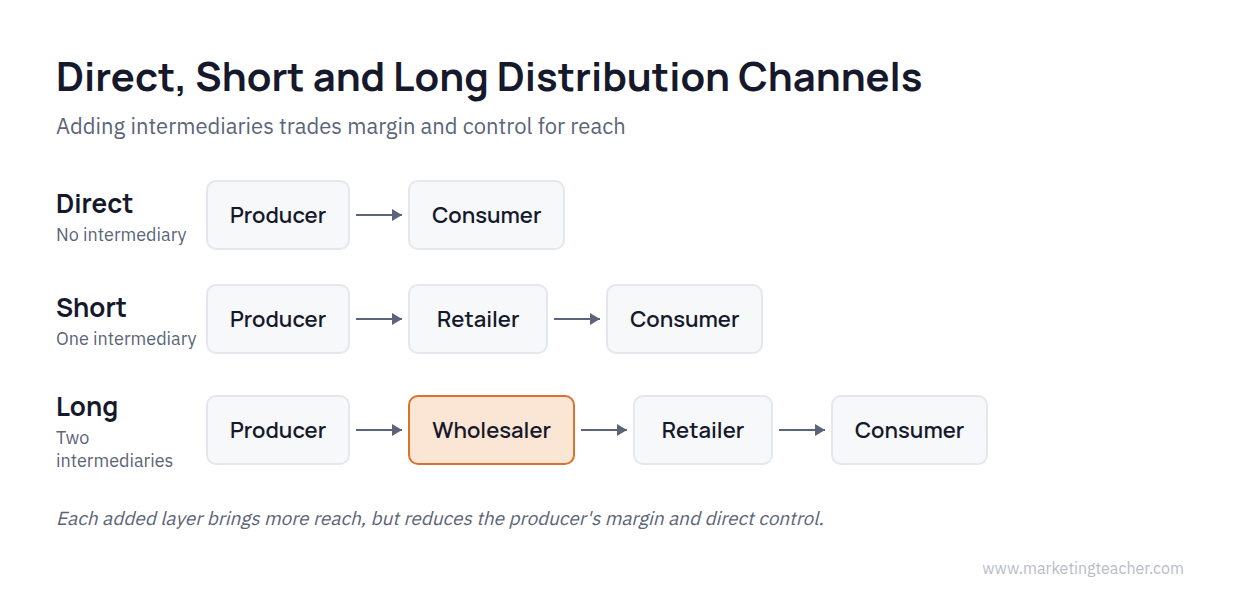
The most basic channel decision is length: how many organisations sit between the producer and the final customer? A direct channel has none at all – the producer sells straight to the customer, as a bakery does from its own shop counter or a software company does through its own website. A short channel adds a single layer, typically a retailer, who buys from the producer and sells on to the public. A long channel adds a wholesaler as well, who buys in bulk from the producer, breaks that bulk down into smaller quantities, and supplies a wide network of retailers the producer could never reach cost-effectively on its own. Bucklin (1966) described this structure as the outcome of a basic trade-off: every extra layer in the channel adds cost and reduces the producer’s control over how the product is presented and priced, but it also adds reach, since each intermediary brings its own established customer relationships and infrastructure. A business also has to decide whether to use a single channel or several in parallel, how many intermediaries to use at each level, and which specific companies to appoint, since working with a direct competitor’s distributor can create conflict between the producer’s own channels.
What Do Wholesalers, Agents and Retailers Actually Do?
Each type of intermediary earns its place in the channel by solving a different problem for the producer. Wholesalers buy in bulk, take ownership of the goods, and break that bulk down into the smaller quantities a retailer can actually sell – a cheese producer, for example, rarely has the storage space to mature its own stock, so a wholesaler holds and matures it before supplying retailers. Agents, by contrast, rarely take ownership of the goods at all; they secure orders on a producer’s behalf in exchange for a commission, which is common in international markets where a producer would otherwise need to build relationships in an unfamiliar country from scratch. Retailers sit closest to the customer and do the most visible work of the channel: they hold and merchandise stock, extend credit in some sectors, set the final selling price, and build a direct relationship with the shopper that neither a wholesaler nor an agent ever has. Kotler and Armstrong (2018) note that a producer’s choice between these intermediaries should always be driven by how well an intermediary’s existing customer base matches the producer’s own target segment, not simply by which option is cheapest.
Licensing, Franchising and Digital Channels
Not every business wants to manufacture, store or sell its own product in every market it wants to reach. Licensing allows another business to manufacture or supply a service under the licence holder’s name in return for a fee, which suits a producer entering a distant market where shipping its own product would be too expensive or where a locally made version would suit customers better. Franchising works similarly but centres on an entire branded format rather than just a product – the well-known fast-food and retail chains found in most shopping centres are built almost entirely on this model, with the franchisor supplying the brand, systems and training while a local franchisee supplies the capital and day-to-day management. Selling directly online has become a channel in its own right alongside these older models: it removes much of the cost of a physical retail presence, lets a niche product reach customers who would never encounter it in a local shop, and increasingly sits alongside, rather than instead of, a producer’s existing wholesale and retail relationships. Behind every one of these channels sits logistics – the physical movement, storage and handling that gets the right stock to the right place at the right time – which has become enough of a specialism in its own right that many businesses now treat supply chain management as a strategic function, not just an operational afterthought.
Summary
Place is about more than simply “where a product is sold” – it is the whole set of decisions about which organisations, if any, sit between a producer and its customers, and how that channel is structured, controlled and coordinated. Direct channels maximise margin and control; short and long channels trade some of both away for reach, using wholesalers, agents and retailers that each bring a different capability to the relationship. Licensing, franchising and digital channels extend these same choices into markets and formats a producer could not easily reach alone. Because place works alongside the other elements of the marketing mix, a channel decision is rarely made in isolation – it has to fit the same target customer and pricing strategy the rest of the mix is built around.

The slides, worksheet, lesson plan and poster for this lesson are free to download and free to use in your course — no sign-up, no permission needed. See the teacher resources →
Assign this lesson to your class:
Using Canvas, Blackboard or Moodle? Copy the link and paste it into your course page or assignment. More ways to add lessons to your LMS.

