
What Is a Social Media Crisis?
Coombs (2007a) defines a crisis as “the perception of an unpredictable event that threatens important expectancies of stakeholders”, adding that such an event can seriously affect an organisation’s performance and lead to negative outcomes. Tuten (2024) describes social media as an environment shaped by consumers as much as by brands, which means a brand cannot control what is said about it.
Coombs’s definition has two important features. First, a crisis is about perception: if customers believe something has gone badly wrong, the brand has a crisis whether or not the facts support that view. Second, the threat is to expectancies: what people expect a brand to do or to be. A social media crisis is a crisis that starts on social media, or is greatly spread and speeded up by it. The difference from a traditional crisis is pace and scale: a complaint can reach millions of people in hours, and the public can see every reply the brand makes.
Issue or Crisis? Spotting the Warning Signs
Not every burst of negative comments is a crisis. Treating every issue as a crisis wastes effort and can make a small problem look bigger.
| Issue | Crisis | |
|---|---|---|
| Scale | Limited, a few complaints | Spreading fast, beyond your own followers |
| Media | Social only | Picked up by news outlets |
| Impact | Annoying but contained | Threatens sales, safety or trust |
| Response | Normal customer-care team | Crisis team and senior managers |
An issue can become a crisis if it is ignored or handled badly, so the line between them should be watched closely.
Early warning through listening. The best time to manage a crisis is before it becomes one. Social listening tools track mentions of the brand, its products and its people, and many can send alerts when volume or negative sentiment suddenly rises. Useful warning signs include:
- a sharp spike in mentions compared with a normal day;
- a fall in sentiment score (see Sentiment Analysis for Digital Marketing);
- the same complaint appearing from many unconnected people;
- journalists, campaigners or high-profile accounts joining the conversation.
The Monitoring vs. Listening lesson explains how to set up this kind of tracking.
Response Principles
When a crisis breaks, four principles guide the first hours:
- Speed: acknowledge the problem quickly, even if you do not yet have all the facts. Silence is filled by rumour.
- Ownership: accept responsibility where it is yours. Blaming others too early can look like dodging.
- Tone: be human, calm and sincere. Pause scheduled posts and promotions, which can look careless during a crisis.
- One voice: agree a single message and a single spokesperson so that social, press, website and customer service all say the same thing.
The Crisis Plan and Holding Statements
A crisis plan is written before it is needed. It usually lists the crisis team and their contact details, who can approve posts out of hours, the likely scenarios (product fault, data breach, offensive post, staff misconduct), and the steps to take in each.
A holding statement is a short, pre-approved message that can be posted within minutes while the facts are gathered. For example: “We’re aware of reports about [issue] and are looking into this urgently. We’ll share an update by [time]. Thank you for your patience.” It buys time without guessing.
Situational Crisis Communication Theory (SCCT)
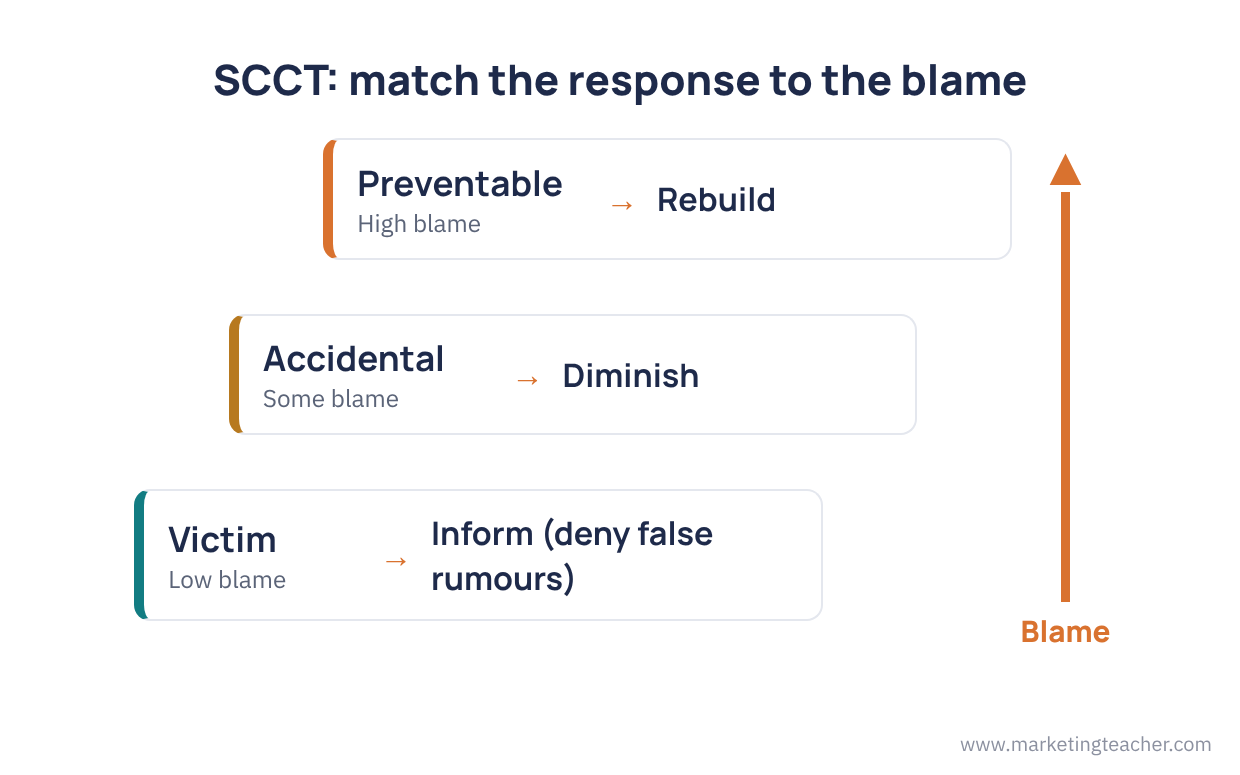
Coombs (2007b) developed Situational Crisis Communication Theory to help organisations match their response to the type of crisis. The key idea is attribution of responsibility: the more the public blames the organisation, the stronger the response must be. SCCT groups crises into three clusters (Claeys, Cauberghe & Vyncke, 2010):
- Victim cluster (low blame): for example, natural disasters, rumours or product tampering by an outsider.
- Accidental cluster (some blame): for example, technical errors that cause product faults.
- Preventable cluster (high blame): for example, human error or management misconduct.
SCCT then offers three main groups of response strategy:
- Deny: reject responsibility (suitable only when the claim is false, such as a rumour).
- Diminish: reduce perceived responsibility through excuse or justification.
- Rebuild: apologise and offer compensation, needed when blame is high.
In the victim cluster, the main job is to inform: give people clear instructions and information so they can protect themselves, and deny only when a claim is false, such as a rumour (Coombs, 2007b).
Coombs (2007b) adds that a history of similar crises increases the blame the public assigns, because it suggests an ongoing problem. An experiment with 316 consumers found that preventable crises did the most harm to reputation and that the rebuild strategy did most to restore it (Claeys, Cauberghe & Vyncke, 2010). Interestingly, that study did not find that matching strategy to crisis type made a significant extra difference, a reminder that theories need testing in practice.
Case Study: KFC’s Chicken Shortage (2018)
In November 2017 KFC UK moved its delivery contract to DHL, working with the food-service company QSL. In February 2018 delivery problems left many of KFC’s roughly 900 UK restaurants without chicken, and hundreds closed for several days (CNBC, 2018). KFC apologised quickly online and kept customers updated on which restaurants were open. On 23 February 2018 it ran full-page adverts in The Sun and Metro, created by the agency Mother London, showing an empty bucket with the letters rearranged to read “FCK” and the line “We’re sorry”. The advert was widely praised because it was fast, took ownership instead of blaming the supplier, and used a tone that matched the brand’s personality. In SCCT terms, KFC used a rebuild strategy (apology and ownership) for a crisis that many customers would have seen as preventable.
Summary
A crisis is a perceived event that threatens what stakeholders expect from a brand (Coombs, 2007a), and social media makes crises faster and more public. Issues should be watched so they do not grow into crises, and listening tools act as an early-warning system. Good responses are fast, owned, human and delivered with one voice, supported by a plan and holding statements written in advance. SCCT (Coombs, 2007b) links the level of blame to the right response, and the KFC case shows a rebuild strategy working well. See also Public Relations (PR) for the wider PR context.
The slides, worksheet, lesson plan and poster for this lesson are free to download and free to use in your course — no sign-up, no permission needed. See the teacher resources →
Assign this lesson to your class:
Using Canvas, Blackboard or Moodle? Copy the link and paste it into your course page or assignment. More ways to add lessons to your LMS.

