
What Is SWOT Analysis?
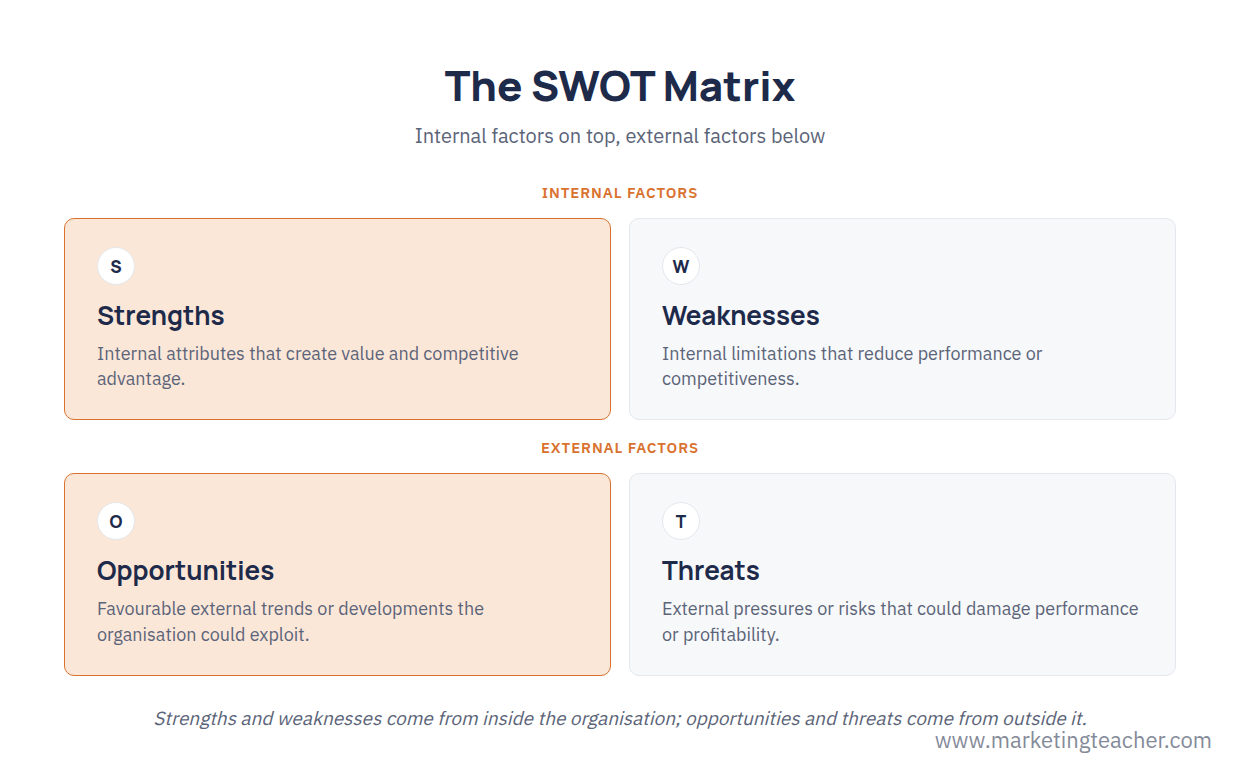
SWOT analysis is one of the most widely used tools in marketing and strategic planning. It gives an organisation a simple, four-part framework for reviewing where it stands today: its Strengths, Weaknesses, Opportunities, and Threats (Kotler & Armstrong, 2018). The technique is generally traced back to Albert Humphrey’s work at the Stanford Research Institute in the 1960s (Humphrey, 1960), and its staying power comes from how quickly it can be applied and how easily its results can be communicated to a wider team.
Internal and External Factors
The four elements of SWOT split neatly into two groups. Strengths and weaknesses are internal factors — things the organisation can control directly, such as its brand reputation, the skills of its staff, or the efficiency of its production process. Opportunities and threats are external factors — conditions in the wider environment that the organisation cannot control but must respond to, such as a new competitor entering the market, a shift in consumer habits, or a change in regulation (Kotler & Armstrong, 2018). Keeping this internal/external line clear is what stops a SWOT analysis turning into an unstructured list of complaints and wishes: a “weakness” that is really outside the organisation’s control, such as rising raw-material prices, belongs under threats, not weaknesses.
Why SWOT Analysis Is Useful
A SWOT analysis helps managers make better strategic decisions by giving them a structured way to evaluate a business and its environment, rather than relying purely on instinct. It supports tasks such as identifying competitive advantages, recognising where the organisation needs to improve, spotting new opportunities early, and anticipating challenges before they cause damage. Because it forces a team to look outward as well as inward, it is often the starting point for a wider strategic review, feeding into more detailed tools such as PEST analysis, Porter’s Five Forces, or the TOWS matrix, which pairs each SWOT factor with its opposite to generate specific strategic options (Weihrich, 1982).
How to Carry Out a SWOT Analysis
The process itself is straightforward. First, list the organisation’s strengths, then identify its weaknesses. Next, look outward for opportunities in the external environment, and identify the threats it faces. The final and most important step is to use the findings to develop strategies that build on strengths, reduce weaknesses, take advantage of opportunities, and minimise threats — the most effective SWOT analyses lead directly to action rather than simply producing four lists.
A few habits separate a useful SWOT analysis from a weak one. Be honest rather than flattering about the organisation’s own position — a SWOT written to please management rather than describe reality is worse than no analysis at all. Support each point with evidence where possible rather than opinion, compare the organisation against named competitors rather than in the abstract, and focus on the handful of issues that genuinely matter rather than padding the lists for the sake of completeness. Because markets move, a SWOT analysis is also a snapshot, not a permanent record — it should be revisited on a regular basis rather than filed away and forgotten.
Strengths and Limitations of the Tool
SWOT analysis is quick, flexible, and easy for a non-specialist audience to understand, which is exactly why it remains one of the most widely used planning tools nearly seventy years after it was developed. It does, however, have real limitations. Its results depend heavily on the judgement of whoever compiles it, so two people analysing the same organisation can produce noticeably different lists, and the tool itself gives no guidance on which issues matter most or which strategy should be chosen (Helms & Nixon, 2010). For this reason, SWOT is usually treated as a starting point for discussion rather than an answer in itself, and it works best alongside evidence — sales data, customer feedback, competitor research — rather than opinion alone.
Summary
SWOT analysis provides a simple but powerful way to evaluate an organisation’s current position by separating what it can control — its strengths and weaknesses — from what it cannot — the opportunities and threats in its external environment (Kotler & Armstrong, 2018). Its value lies less in the four lists themselves and more in the strategies they lead to: building on strengths, closing weaknesses, seizing opportunities, and defending against threats.

The slides, worksheet, lesson plan and poster for this lesson are free to download and free to use in your course — no sign-up, no permission needed. See the teacher resources →
Assign this lesson to your class:
Using Canvas, Blackboard or Moodle? Copy the link and paste it into your course page or assignment. More ways to add lessons to your LMS.

