
Why the International Marketing Environment Is More Complex
Every marketer already has to analyse the political, economic, social, technological, environmental and legal (PESTEL) forces acting on their business, alongside the competitive forces covered by tools such as SWOT and Five Forces Analysis. Cateora, Money, Gilly and Graham (2023) point out that international marketing does not remove any of this analysis, it multiplies it, since each country a company enters has its own distinct combination of these forces. A regulation, cultural norm or competitive structure that a marketer has already accounted for at home tells them very little about what to expect in a new market, which is why the international marketing environment has to be assessed market by market rather than assumed to be a variation on the domestic one.
Controllable and Uncontrollable Forces
Cateora et al. (2023) describe the international marketing task as a set of forces. Some the marketer can control. Many they cannot. The skill is to adjust what you control so that it fits what you cannot.
Marketing controllables. These are the decisions the firm makes for itself. They are product, price, promotion and channels of distribution, plus marketing research. Together they form the marketing mix. The aim is a marketing programme that adjusts well to an uncertain business climate.
Domestic uncontrollables. These are forces in the home country. They include political and legal forces, the economic climate and the competitive structure. They can have a direct effect on a foreign venture, even though they sit at home.
Foreign uncontrollables. Each new market adds its own set. Cateora et al. (2023) list political and legal forces, economic forces, competitive forces, the level of technology, the structure of distribution, geography and infrastructure, and cultural forces. A PESTEL analysis of each country helps you map them. The foreign firm also has an “alien status”. It is run by outsiders, and the local culture is foreign to it. This adds more uncertainty.
Tariff Barriers
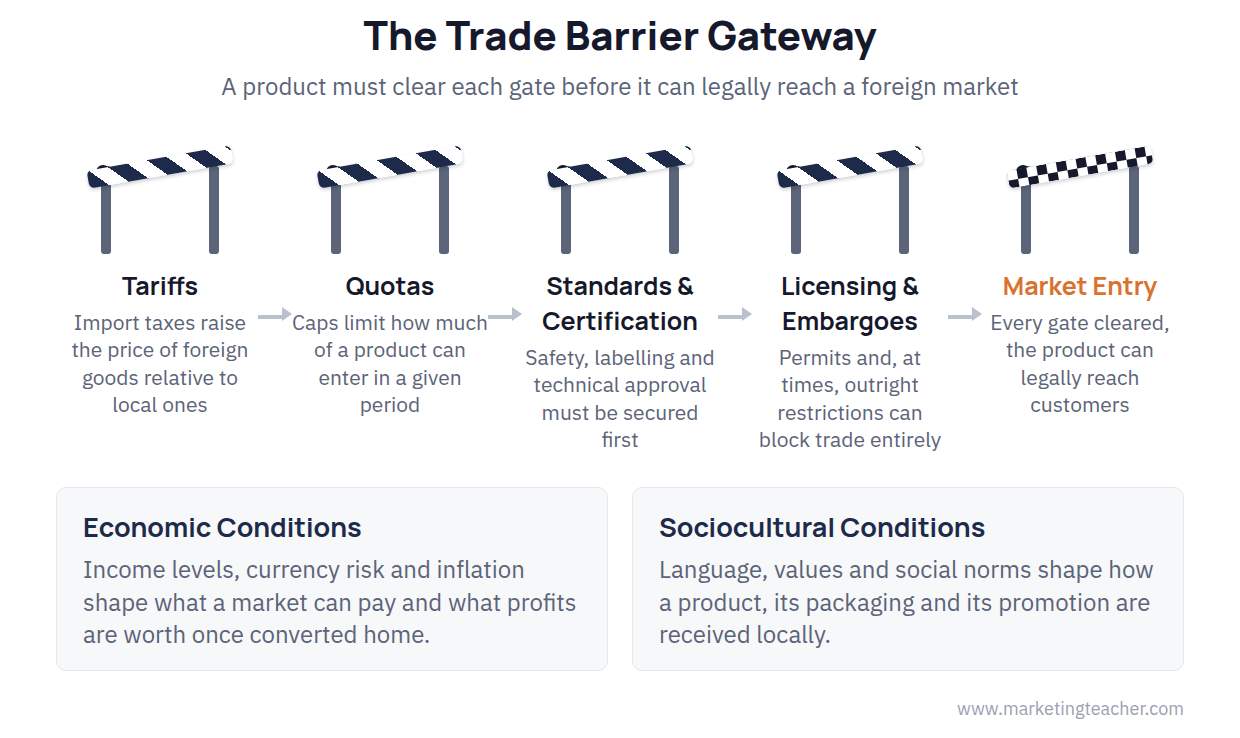
A tariff is a tax a government charges on goods entering its country, raising the price of imported products relative to those made locally. Governments use tariffs to protect domestic industries from foreign competition, to raise revenue, or in response to trade disputes with other countries. A company exporting into a market with high tariffs on its product category may find its price advantage disappears entirely once the tariff is added, forcing a choice between absorbing the cost, raising the price, or manufacturing closer to that market instead. Because tariff rates are set against a detailed international product classification system, two very similar products can face noticeably different rates, which is why exporters typically confirm the exact classification and rate for their specific product before finalising an entry price, rather than relying on a general sense of “the tariff” for a market.
Non-Tariff Barriers
Non-tariff barriers restrict trade without directly taxing it, and are often harder for a company to anticipate than a published tariff rate. Import quotas cap the quantity of a product that can enter a country in a given period. Local content requirements oblige a share of a product to be manufactured or sourced domestically. Product standards and certification requirements, covering safety, labelling or technical specifications, can require lengthy and costly approval processes before a product can legally be sold. Import licensing schemes and outright embargoes can restrict or block trade entirely, sometimes for political rather than purely economic reasons. Cateora, Money, Gilly and Graham (2023) note that non-tariff barriers have become an increasingly significant obstacle to international trade precisely because they are less visible and more varied than a straightforward tariff schedule.
Economic Differences
Beyond formal trade barriers, economic conditions vary considerably between countries in ways that shape marketing decisions directly. Income levels determine what price points and product tiers a market can realistically support. Currency exchange rates affect both the price a foreign customer actually pays and the value of profits once converted back into the company’s home currency, adding a layer of financial risk that a purely domestic business does not face. Inflation, interest rates and the general stage of a country’s economic development all influence how much disposable income is available for the kinds of products and services a company may be marketing. A simple measure such as GDP per capita is often used as an early screening tool when comparing several candidate markets, though it needs to be read alongside income distribution, since a high national average can still sit alongside a small, wealthy segment and a much larger population with far less spending power.
Sociocultural Differences
Cultural values, language, religion, social norms and consumer habits can all affect how a product, its packaging and its promotion are received in a new market. A colour, symbol or slogan that carries a positive association in one culture can carry a neutral or even negative one in another, and family structures, gender roles and attitudes toward status or thrift can all shape what a market considers an appropriate purchase. These sociocultural forces sit alongside the economic and legal barriers already discussed as part of the broader PESTEL analysis a company should run separately for each market it enters, rather than assuming its domestic PESTEL findings will transfer unchanged.
Summary
The international marketing environment is shaped by tariff and non-tariff trade barriers alongside the economic and sociocultural conditions unique to each market a company enters (Cateora, Money, Gilly and Graham, 2023). Because these forces vary considerably from country to country, a company cannot simply apply the findings of a domestic PESTEL or SWOT analysis to a new market; it needs to repeat that analysis for each market individually, budgeting for the trade barriers, currency risk and cultural differences it is likely to encounter along the way. Cateora et al. (2023) add a useful model: the marketer adjusts the controllable marketing mix to fit the uncontrollable domestic and foreign forces of each market.
The slides, worksheet, lesson plan and poster for this lesson are free to download and free to use in your course — no sign-up, no permission needed. See the teacher resources →
Assign this lesson to your class:
Using Canvas, Blackboard or Moodle? Copy the link and paste it into your course page or assignment. More ways to add lessons to your LMS.

