
What Is Value Chain Analysis?
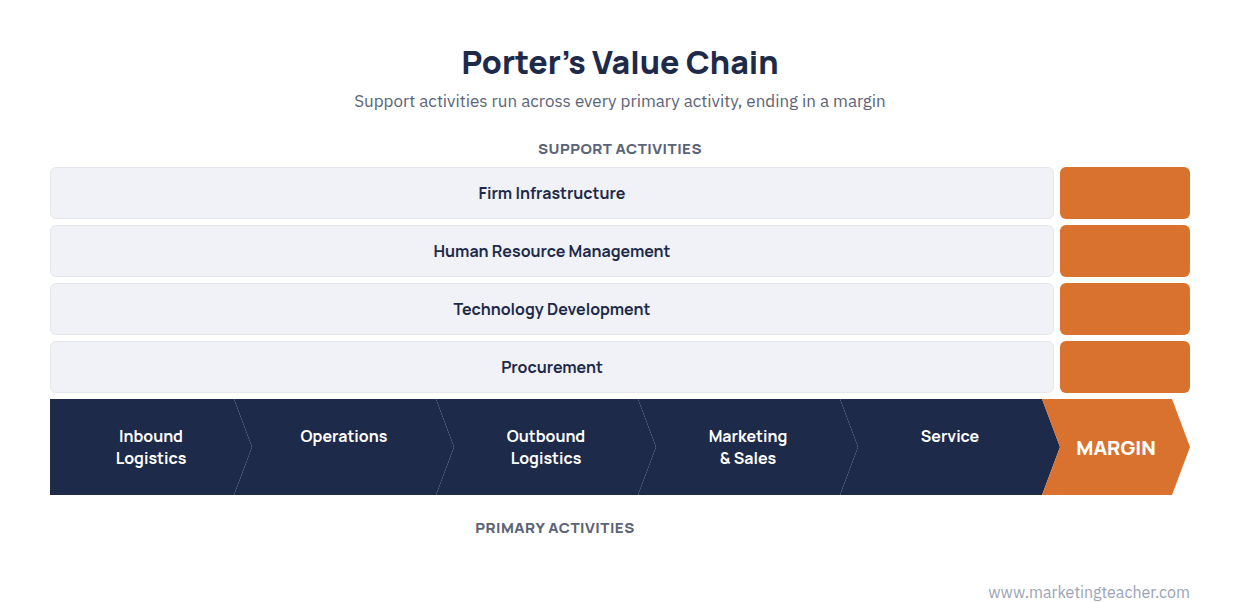
Value chain analysis is a way of breaking an organisation down into the discrete activities it performs, so that the cost and value each activity contributes can be examined separately. Porter (1985) introduced the framework in Competitive Advantage: Creating and Sustaining Superior Performance, arguing that competitive advantage cannot be understood by looking at a firm as a whole – it comes from the many discrete activities a firm performs, and whether each one is done more cheaply or more distinctively than a rival’s equivalent activity. The chain runs from the raw materials a business buys through to the finished product or service reaching the customer, with a margin – the difference between the value created and the cost of creating it – at the end.
The Primary Activities
Porter’s model groups the activities directly involved in producing and delivering an offering into five primary activities. Inbound logistics covers receiving, storing, and distributing inputs – materials handling, warehousing, and stock control. Operations transforms those inputs into the finished product or service – manufacturing, assembly, testing. Outbound logistics covers storing and physically distributing the finished output to buyers – order processing, scheduling, delivery. Marketing and sales covers the activities that persuade buyers to purchase and provide the means for them to do so – advertising, channel selection, and pricing. Service covers activities that maintain or enhance the value of the offering after sale – installation, repair, and customer support.
The Support Activities
Four support activities run across the whole chain rather than belonging to any one stage. Procurement covers the purchasing of inputs used anywhere in the chain, not just raw materials. Technology development covers the know-how, procedures, and technological inputs that improve a product or process. Human resource management covers recruiting, training, developing, and compensating the people who carry out every other activity. Firm infrastructure covers general management, planning, finance, and quality control – the activities that support the entire chain rather than any single link in it. Because support activities affect every primary activity at once, an improvement in one of them – better staff training, for example – can raise the value or lower the cost of several primary activities simultaneously.
Linkages Between Activities
Porter (1985) also stressed that activities are not independent of one another – the way one activity is performed can raise or lower the cost of another, and these linkages are often where the most durable advantages are found. A firm that invests more in inbound quality inspection, for example, may be able to run its operations and service activities more cheaply, since fewer defective units reach the production line or the customer. A competitor that copies only the visible activity – say, a fast delivery service – without also copying the linkage that supports it, such as a warehouse location strategy, often fails to reproduce the advantage at the same cost. This is one reason value chains built on linkages tend to be harder for rivals to imitate than value chains built on any single standout activity.
Using the Framework in Practice
Applying value chain analysis usually starts with mapping the organisation’s actual activities under the nine categories above, rather than assuming they will match a textbook example exactly – a service business may have no meaningful “outbound logistics” stage at all, while a retailer’s “operations” may consist mostly of merchandising and store layout. Each activity is then benchmarked against competitors on cost and on the value customers place on it, which usually reveals that most activities are close to industry norms, with only a small number driving the real difference in performance. That short list of activities is where management attention and investment should concentrate, since spreading effort evenly across the whole chain wastes resources on activities that were never going to be a source of advantage.
Value Chain Analysis and Competitive Advantage
Value chain analysis is most useful alongside Generic Strategies, since it shows concretely where a cost leadership or differentiation advantage actually comes from, rather than treating it as an abstract choice. A firm pursuing cost leadership should expect most of its chain to look unremarkable, with a small number of activities run at genuinely lower cost than rivals; a firm pursuing differentiation should expect the reverse – most activities close to industry norms, with one or two run in a way that is difficult to copy. The value chain also complements Five Forces Analysis: Five Forces explains the pressures acting on an industry from outside, while the value chain explains which of a firm’s own activities determine how well it can withstand them.
Summary
Porter’s (1985) value chain breaks an organisation into five primary activities – inbound logistics, operations, outbound logistics, marketing and sales, and service – supported by procurement, technology development, human resource management, and firm infrastructure, ending in a margin. Its main value is diagnostic: it shows exactly where cost or differentiation advantage is actually created, which makes it a natural companion to Generic Strategies and Five Forces Analysis.
The slides, worksheet, lesson plan and poster for this lesson are free to download and free to use in your course — no sign-up, no permission needed. See the teacher resources →
Assign this lesson to your class:
Using Canvas, Blackboard or Moodle? Copy the link and paste it into your course page or assignment. More ways to add lessons to your LMS.

