
What Is the Whole-Channel View of International Distribution?
A company that successfully gets a shipment of product across a border has not finished the job of international distribution. It has finished the easy half. The pallet still has to move on from the port, airport or customs warehouse into the hands of a shopper who may live somewhere with almost no modern logistics infrastructure, or in a market where very few households own a car, or in a culture where people expect to be sold to in person rather than pick a product off a shelf themselves. Marketing academics call the discipline of planning for both halves of that journey the whole-channel view, and treat it as one of the genuinely distinct problems that international marketing, as opposed to domestic marketing, has to solve.
Two Definitions, and Where They Overlap
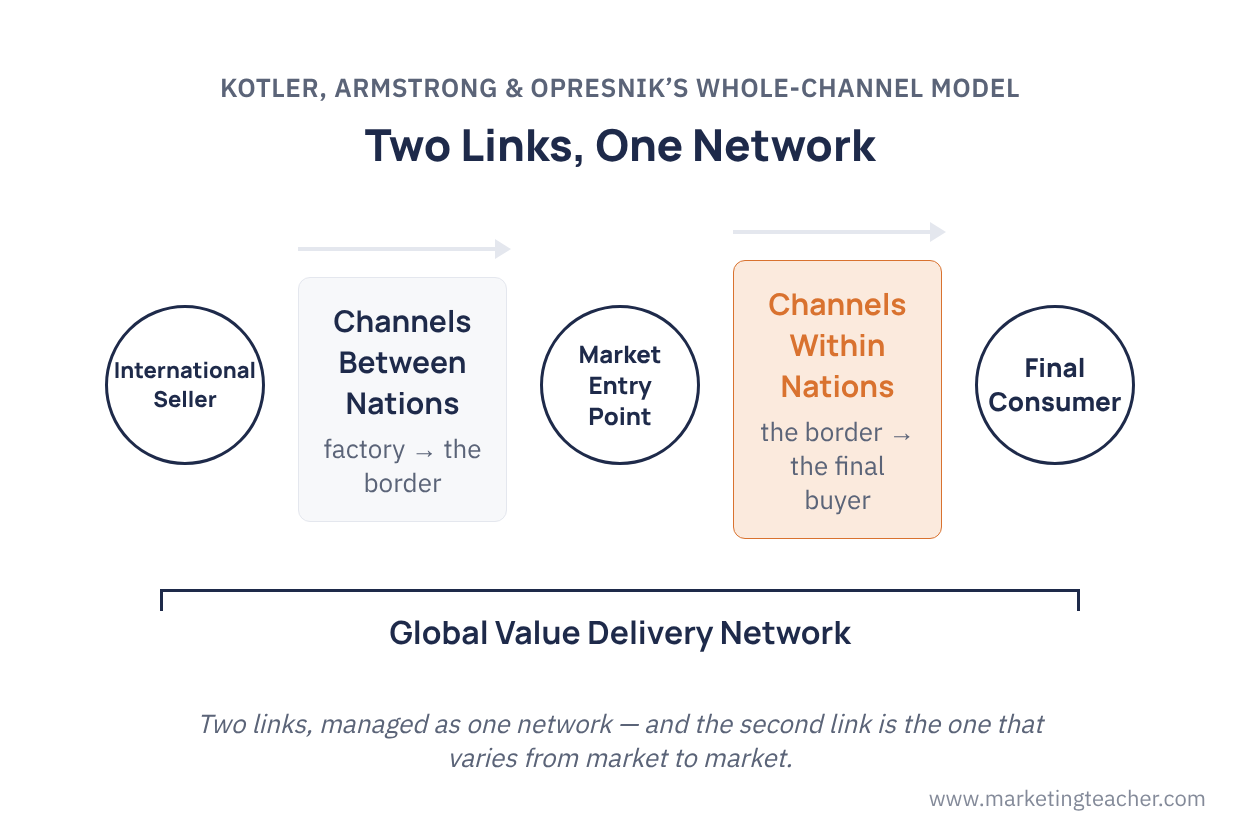
Kotler, Armstrong and Opresnik (2018) give the whole-channel view a precise definition: designing international channels that take into account “the entire global supply chain and marketing channel, forging an effective global value delivery network.” Their own model sets out exactly two links in that chain — channels between nations, which move a company’s product from its factory to the border of the country where it will be sold, and channels within nations, which move it onward from that entry point to the final buyer.
Cateora, Gilly and Graham (2011) approach the same underlying problem from the receiving end rather than the sending end. Instead of naming a two-link model, they describe every country’s distribution structure as “unique and, in the short run, fixed” — shaped by local tradition, infrastructure and economic development rather than something a company can import wholesale from its home market.
The two views fit together rather than compete. The whole-channel view supplies the structural map: two links, managed as one network. The “fixed structure” view explains why the second of those links so rarely behaves like the first: a foreign country’s internal distribution system is not a blank space waiting for a company’s channel strategy, it is an existing, locally rooted system the company has to fit into or work around.
Two Links, Not One
The first link, channels between nations, is largely a question of mode of entry: exporting through an agent or distributor, licensing a local partner, or investing directly in foreign operations all move product to a country’s border in a fairly standard, well-documented way. The second link, channels within nations, starts at that entry point and ends with the final consumer, and this is the one that resists a single global solution. A channel design that works perfectly for the first link can still fail completely at the second, because the second link has to match a retail and distribution structure the company did not build and cannot quickly change.
Why the Second Link Is the Hardest
Large-scale retail chains dominate how products reach shoppers in the United States, but Cateora, Gilly and Graham (2011) point out that most retailing in many other countries is done by small, independent retailers — in India or Indonesia, millions of retailers operate tiny shops or sell in open markets instead. No single channel design serves both kinds of market at once, which is why the same global brand can look completely different on the shelf, or off it, from one country to the next.
Even where the store format looks familiar, the way products actually get sold inside it can differ sharply. In China, consumer brands sold through large retail chains often rely not on Western-style self-service but on armies of uniformed in-store promoters — “push girls” — hired to dispense samples and pitch products person to person, because shoppers want to feel the product and get a detailed understanding before they buy (Kotler, Armstrong and Opresnik, 2018). A company whose international expansion has only ever involved shipping to a distributor can be caught out by a requirement like this one, because it sits inside the second link, not the first.
Summary
The whole-channel view splits international distribution into two linked problems: channels between nations, which get product to a country’s border, and channels within nations, which get it the rest of the way to a real customer. A country’s distribution structure being locally “fixed” rather than freely chosen explains why the second link is the one that keeps catching companies out, and Coca-Cola’s pushcarts, Nestlé’s floating supermarket and Domino’s water wells all show the same lesson from different angles: there is no shortcut around designing for the market you are actually entering, not the one you planned for on a spreadsheet. The same logic extends into digital markets, where cross-border e-commerce raises its own version of the within-nations problem, and feeds directly into decisions about international pricing, since a longer or less efficient channel adds cost at every link it passes through.
The slides, worksheet, lesson plan and poster for this lesson are free to download and free to use in your course — no sign-up, no permission needed. See the teacher resources →
Assign this lesson to your class:
Using Canvas, Blackboard or Moodle? Copy the link and paste it into your course page or assignment. More ways to add lessons to your LMS.

