
What Is Paid, Owned and Earned Media?
The framework was popularised by Forrester analyst Sean Corcoran. Corcoran (2009) gave three short definitions:
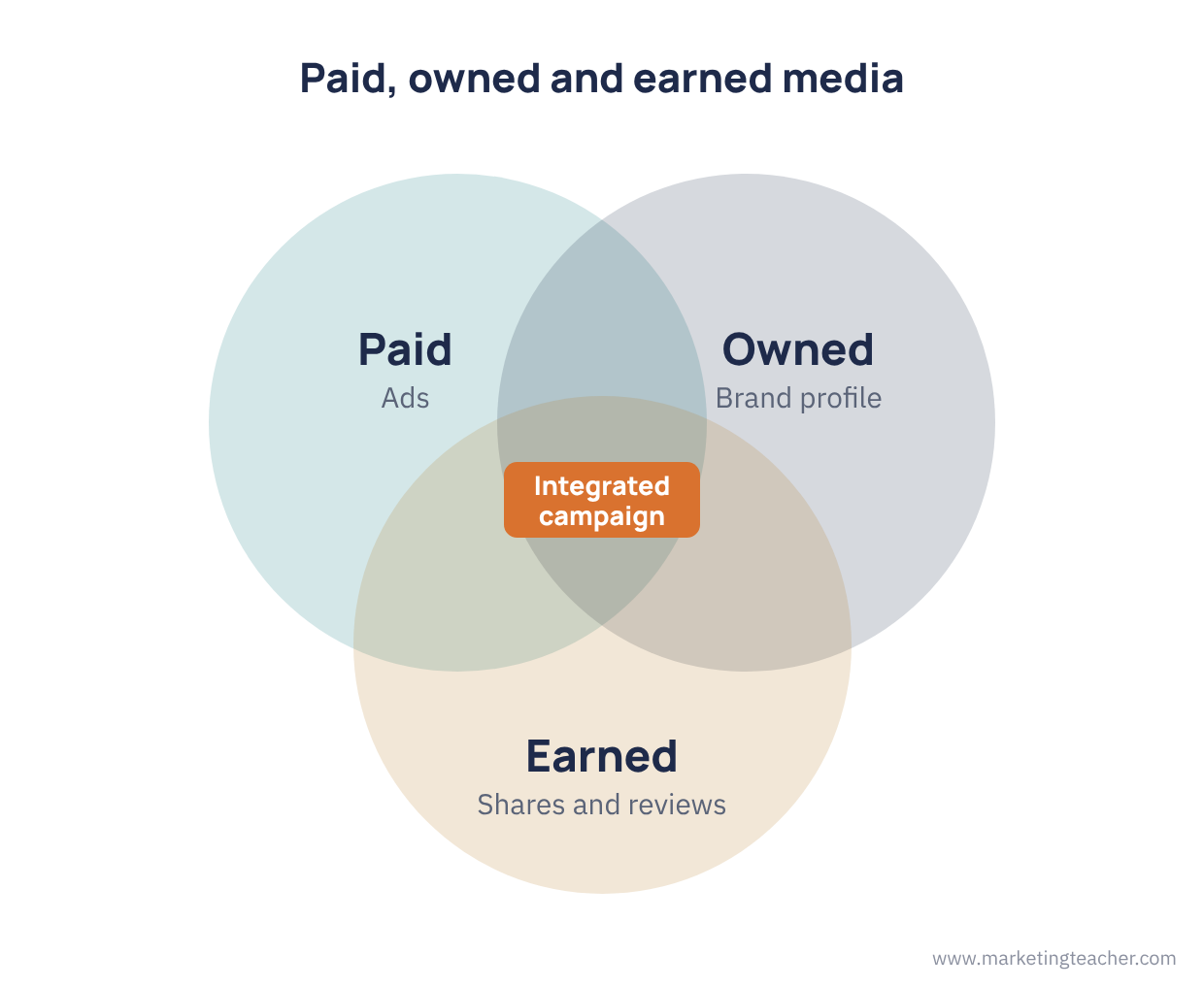
- Owned media is a “channel a brand controls”, such as its website, app, blog or social media accounts.
- Paid media is when a “brand pays to leverage a channel”, such as display adverts, sponsored posts or paid search.
- Earned media is “when customers become the channel”, through shares, reviews, word of mouth and press coverage.
A year later, Lovett and Owyang (2010) argued that social marketing should be measured against business objectives such as dialogue and advocacy, which they described as taking advantage of word of mouth and viral activity. In other words, they treated earned attention as a result that brands could plan for and measure, rather than a lucky accident.
Gini Dietrich’s PESO model, launched in her book Spin Sucks (Dietrich, 2014), splits the same territory into four: paid, earned, shared and owned. Dietrich places social media in its own “shared” category.
How do these differ? Corcoran’s definitions are built around control and cost. Who controls the channel, and who pays? Lovett and Owyang take a measurement view: earned media is an outcome to track. Dietrich takes a public relations view: she separates earned media (mainly press coverage) from shared media (social posts and shares). In Corcoran’s model, both of these count as earned.
Where Does Social Media Fit?
Social media is unusual because it can be all three types at once. Tuten and Solomon (2018) map paid, owned and earned media across the four zones of social media. For example:
- A brand’s Instagram profile and the posts it publishes there are owned. (The brand controls the content, but not the platform or its rules.)
- A promoted post or a TikTok advert is paid.
- A customer’s unboxing video, a share or a positive comment is earned.
This is why marketers often talk about paid social and organic social. Organic social covers the unpaid posts a brand publishes on its own accounts, plus the earned activity they trigger. Paid social covers adverts and boosted posts that buy reach. The Social Media Advertising lesson explains how paid social campaigns are built.
Strengths and Weaknesses of Each Type
| Type | Strengths | Weaknesses |
|---|---|---|
| Paid | Fast, scalable, precisely targeted, easy to measure | Costs money for every view; reach stops when spending stops; audiences may ignore adverts |
| Owned | Brand controls the message; low running cost; builds long-term assets | Slow to grow; organic reach on social platforms is limited by algorithms |
| Earned | Most trusted, because it comes from others; can spread quickly | Cannot be bought or controlled; can be negative as well as positive |
Earned media can be powerful. In a study of a microlending website, Stephen and Galak (2012) found that each mention in traditional media (newspapers or TV) had the largest single effect on sales. Social earned media, such as blog and online community mentions, appeared far more often, so its total effect on sales was larger. Social mentions also helped trigger traditional press coverage.
How Paid, Owned and Earned Media Work Together
In practice, the three types feed each other:
- Owned content is the starting point. A brand publishes something worth seeing on its own channels.
- Paid media gives it a push. A small budget gets the best-performing posts in front of a wider, targeted audience.
- Earned media multiplies the reach. People who see it share, comment, review or create their own content.
- Earned content is reused on owned channels. With permission, the brand reposts customer content, which feeds the next cycle.
The order is not fixed. Sometimes earned media comes first, for example when a customer’s post goes viral and the brand then puts paid budget behind it. The important point is that each type makes the others more effective. Influencer partnerships blur the lines further. Because the brand pays, they are paid media and must be disclosed as adverts, even though they look like earned media. See Influencer Marketing.
Using the Framework in Planning
When you plan a campaign, use POE as a checklist:
- Owned: What will we publish, where, and how often?
- Paid: Which posts deserve budget, and which audience should see them?
- Earned: What will make people want to share, review or talk about us?
The framework also shapes measurement. Paid media is judged on cost and conversions, owned media on reach and engagement, and earned media on mentions, shares and sentiment. See Social Media Metrics: The DATA Framework for how to set these measures.
Summary
Paid, owned and earned media describe three ways a brand reaches people: buying space, using its own channels, or being talked about by others (Corcoran, 2009). Lovett and Owyang (2010) helped turn earned activity such as advocacy into something to measure, and the PESO model (Dietrich, 2014) adds “shared” media as a separate category for social. On social platforms the three overlap, and paid and organic social are most effective when used together. Owned content gives a campaign substance, paid media gives it reach, and earned media gives it credibility.
The slides, worksheet, lesson plan and poster for this lesson are free to download and free to use in your course — no sign-up, no permission needed. See the teacher resources →
Assign this lesson to your class:
Using Canvas, Blackboard or Moodle? Copy the link and paste it into your course page or assignment. More ways to add lessons to your LMS.

