
What Is a Digital Marketing Internal Audit?
A digital marketing internal audit is the first half of the broader marketing audit McDonald (2007) describes as the essential starting point for any marketing plan: before a business decides where it wants to go, it needs an honest answer to where it stands right now, looked at from the inside. Unlike competitor research, which looks outward at rivals, an internal audit turns the same structured questioning onto the business’s own resources and its own execution of the marketing mix. McDonald’s broader framework also includes an external audit, covering the market, competitors, and the wider environment, but the internal audit is deliberately narrower: it asks only what a business actually has to work with, and how well it is currently using it. Skipping this step is a common planning mistake, since a strategy built on an inflated view of internal capability tends to fail at the implementation stage, not the drawing-board stage. It is also a mistake that is easy to make precisely because the internal audit can feel less urgent than watching a competitor’s next move, even though it is the one review entirely within a business’s own control to act on immediately.
The Five Resource Categories to Review
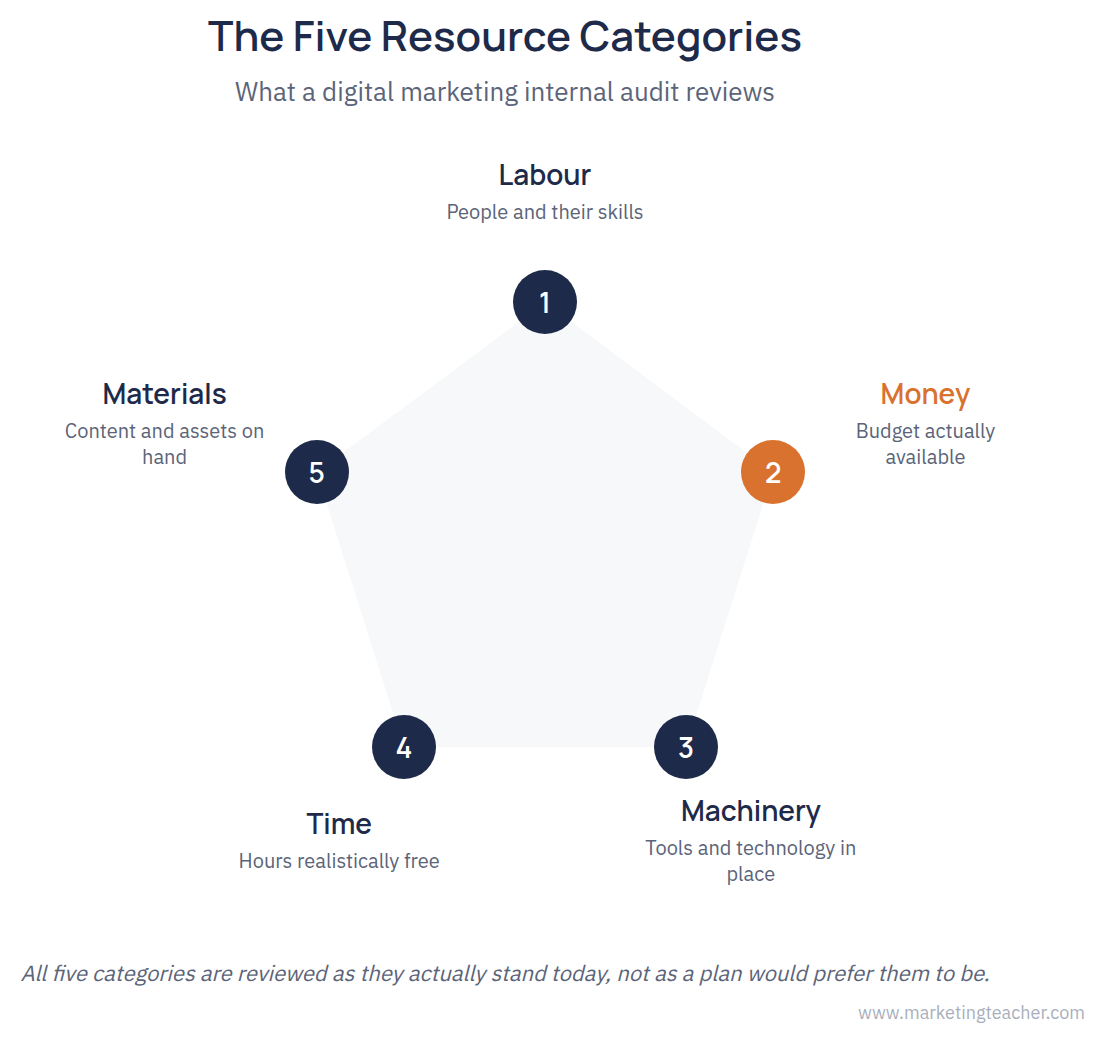
A practical way to structure an internal audit is to work through five resource categories in turn. Labour covers the people available to deliver digital marketing activity and whether their skills match what the plan will require. Money covers the budget actually available, not the budget a business would like to have, since a plan sized to a wish rather than a figure rarely survives its first quarter. Machinery covers the technology and tools already in place, from the website platform and analytics setup to any marketing automation or email tools, and where gaps in that toolkit would need to be filled. Time covers the hours realistically available from the people doing the work once their existing responsibilities are accounted for, which is frequently overestimated in a plan written by someone other than the person who will execute it. Materials covers the content, assets, and data a business already holds, such as existing photography, customer records, and past campaign results, which can often be reused rather than rebuilt from scratch.
Auditing the Marketing Mix from the Inside
Once the resource picture is clear, the same internal lens is applied to each element of the marketing mix in turn, product, price, place, promotion, people, process, and physical evidence, the seven-part model Booms and Bitner (1981) extended from the original four Ps to fit services businesses, asking a simple question of each: are we getting this right? For product, does the current online offering still match what customers actually want. For price, is pricing set correctly relative to the value being delivered and to competitors. For place, how efficient and effective is distribution and online availability. For promotion, are marketing communications actually reaching and persuading the right audience. For people, are the right people facing customers with the right skills. For process, are customer-facing processes efficient or a source of friction. For physical evidence, does the business’s visible presence, from its website design to its packaging, support the image it wants to project. Answering each honestly, rather than assuming a passing grade, is what turns this from a formality into a genuinely useful exercise.
Summary
A digital marketing internal audit answers the question of where a business stands today, from the inside, before any plan is built on top of that answer. Working through McDonald’s five resource categories, labour, money, machinery, time, and materials, gives a structured starting point, and applying the same honest lens to each element of the marketing mix extends that audit across the whole of current practice. Used properly, the internal audit shapes a plan around what a business genuinely has available, rather than around what it wishes it had.

The slides, worksheet, lesson plan and poster for this lesson are free to download and free to use in your course — no sign-up, no permission needed. See the teacher resources →
Assign this lesson to your class:
Using Canvas, Blackboard or Moodle? Copy the link and paste it into your course page or assignment. More ways to add lessons to your LMS.

