
What Is Marketing Myopia?
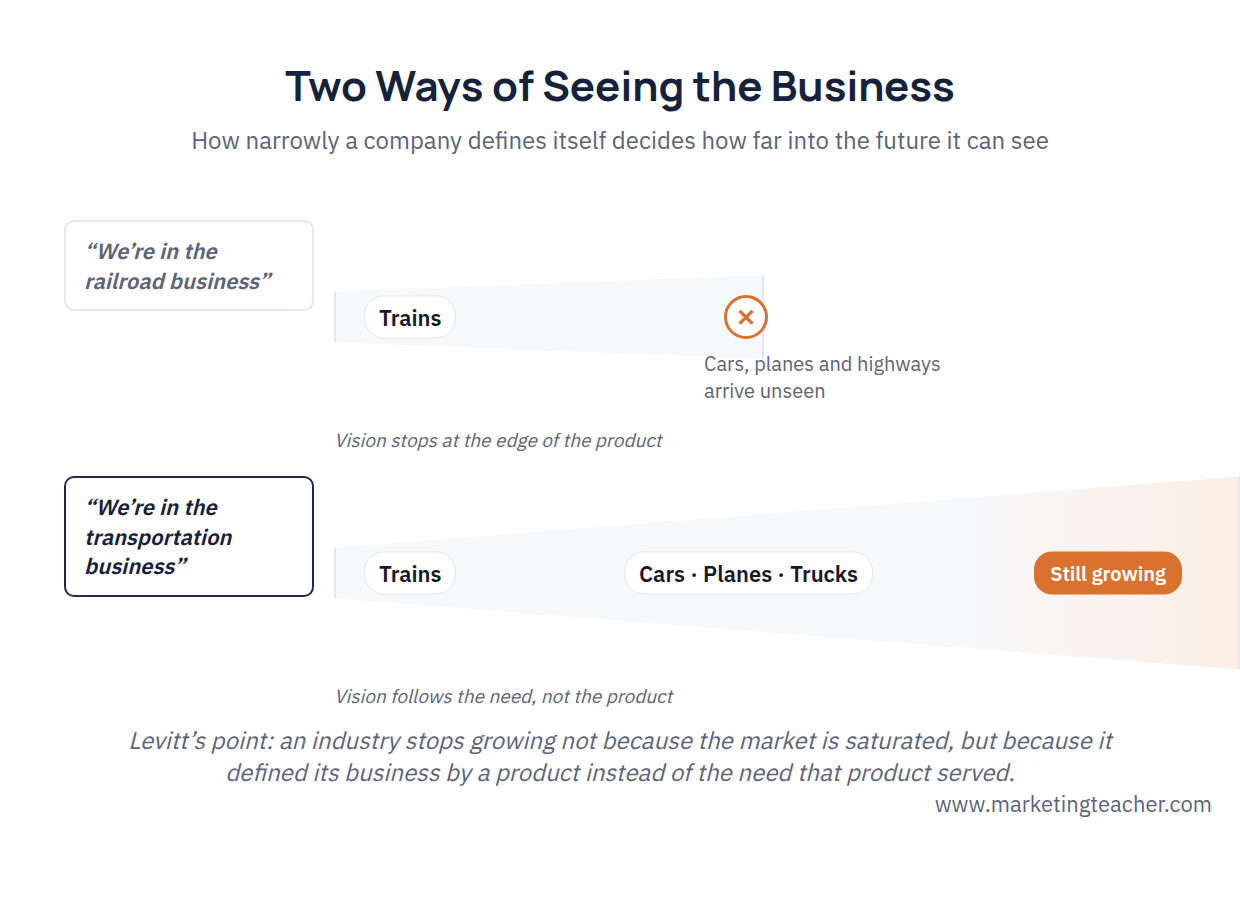
In 1960, Harvard Business School professor Theodore Levitt published an essay in the Harvard Business Review that has since become one of the most reprinted articles the journal has ever run. His argument was simple but unsettling: the history of every dead or dying “growth” industry shows the same self-deceiving cycle of bountiful expansion followed by undetected decay (Levitt, 1960). Industries do not usually stop growing because their market is saturated. They stop growing because they mistake what the company happens to make for what the customer actually needs – a narrow, product-first way of seeing the business that Levitt named marketing myopia.
The Self-Deceiving Cycle: Four Beliefs That Blind an Industry
Levitt (1960) traced this blindness to four beliefs that comfortable, growing industries tend to hold at once. The first is a quiet assumption that growth is guaranteed simply because the population and the economy are expanding, so there is no urgent need to think harder about customers. The second is a conviction that there is no substitute of any consequence for the industry’s core product, which leaves a business unprepared for a competitor that never looked like competition until it arrived. The third is too much faith in the cost advantages of mass production, which pulls management’s attention toward the factory floor and away from the market. The fourth is a preoccupation with the product itself, because a physical product lends itself so well to measurable, fundable, scientific improvement – while the far messier task of understanding what customers actually want gets quietly neglected. Together, these four beliefs let an industry keep polishing a product long after the world has moved on to asking a different question.
Where Real Industries Got It Wrong
Levitt’s central example is the American railroad industry. Railroads stopped growing, he argued, not because the demand for moving people and goods disappeared, but because the industry defined itself as being in the railroad business rather than the transportation business. That narrow definition of “the product we currently run” left railroads unprepared to compete when cars, trucks, and airplanes arrived offering the same underlying benefit through a different technology. He pointed to the same pattern elsewhere: dry cleaners who never saw synthetic, easy-care fabrics coming because they defined themselves around a cleaning process rather than clean clothes, and oil companies so fixed on crude and refining that they repeatedly let outsiders capture the opportunities in natural gas and alternative fuels (Levitt, 1960). In each case, the product looked safe right up until it wasn’t.
From Levitt to Today: The Drill Bit and the Hole
The same idea is still taught the same way more than six decades later, just with a newer illustration. Kotler, Armstrong and Opresnik (2018) make the point with a manufacturer of quarter-inch drill bits: the manufacturer may believe the customer needs a drill bit, but what the customer actually needs is a quarter-inch hole. A company that only ever improves the bit, and never asks whether some other method might make the hole better, cheaper, or faster, is practising exactly the myopia Levitt described. The same test applies to a product moving through its product life cycle: a business that defines itself by its current product will keep polishing that product as it matures and declines, while a business that defines itself by the customer need behind it is already working on whatever comes next. This is also the practical difference between the production concept, which focuses inward on making and improving what the company already makes, and the marketing concept, which starts from customer needs and works backward to the product.
Summary
Marketing myopia is Theodore Levitt’s term for the narrow, product-first thinking that leads successful, growing industries into decline. It takes hold through four self-deceiving beliefs: faith in automatic growth, confidence that no substitute exists, an overemphasis on production efficiency, and a preoccupation with the product itself rather than the customer need behind it. Levitt’s own examples – railroads, Hollywood, dry cleaning, oil – are decades old, but what is marketing comes down to the same question he asked in 1960: is your business defined by what you make, or by the need you meet?
The slides, worksheet, lesson plan and poster for this lesson are free to download and free to use in your course — no sign-up, no permission needed. See the teacher resources →
Assign this lesson to your class:
Using Canvas, Blackboard or Moodle? Copy the link and paste it into your course page or assignment. More ways to add lessons to your LMS.

