
Why Does International Expansion Fail?
Expanding abroad looks simple on a slide: pick a market, adapt the offer, launch. In practice it fails often, and rarely because the product itself was wrong. In 2026 the Australian fast-food chain Guzman y Gomez (GYG) wrote off more than $67 million retreating from the United States after six years of trying to make its US stores profitable. Marks & Spencer closed its last Chinese stores in 2016, eight years after opening with real optimism. Tesco sold its loss-making Fresh & Easy chain in the US in 2013. Three different industries, three different decades, the same underlying pattern — one that international-marketing researchers have a name for.
Liability of Foreignness: Two Definitions
The clearest name for this pattern comes from Srilata Zaheer, who coined it in the Academy of Management Journal: liability of foreignness is “the costs of doing business abroad that result in a competitive disadvantage for an MNE subunit” (Zaheer, 1995).
Writing almost 25 years later about firms expanding out of Latin America, Paul and Mas (2020) use a narrower, more applied version: liability of foreignness is “social costs associated with a lack of knowledge and experience in a foreign country”, including entry barriers such as unfamiliar tax, labour, environmental and safety rules a local competitor would already know how to navigate.
The two definitions describe the same problem at different distances. Zaheer’s original is the broad economic claim: being foreign is, on its own, a cost, whatever a firm sells. Paul and Mas narrow it to something a marketer can actually plan against — the specific knowledge and compliance gaps a firm needs to close before it can compete with a firm that already belongs there.
The Three Problems Firms Underestimate
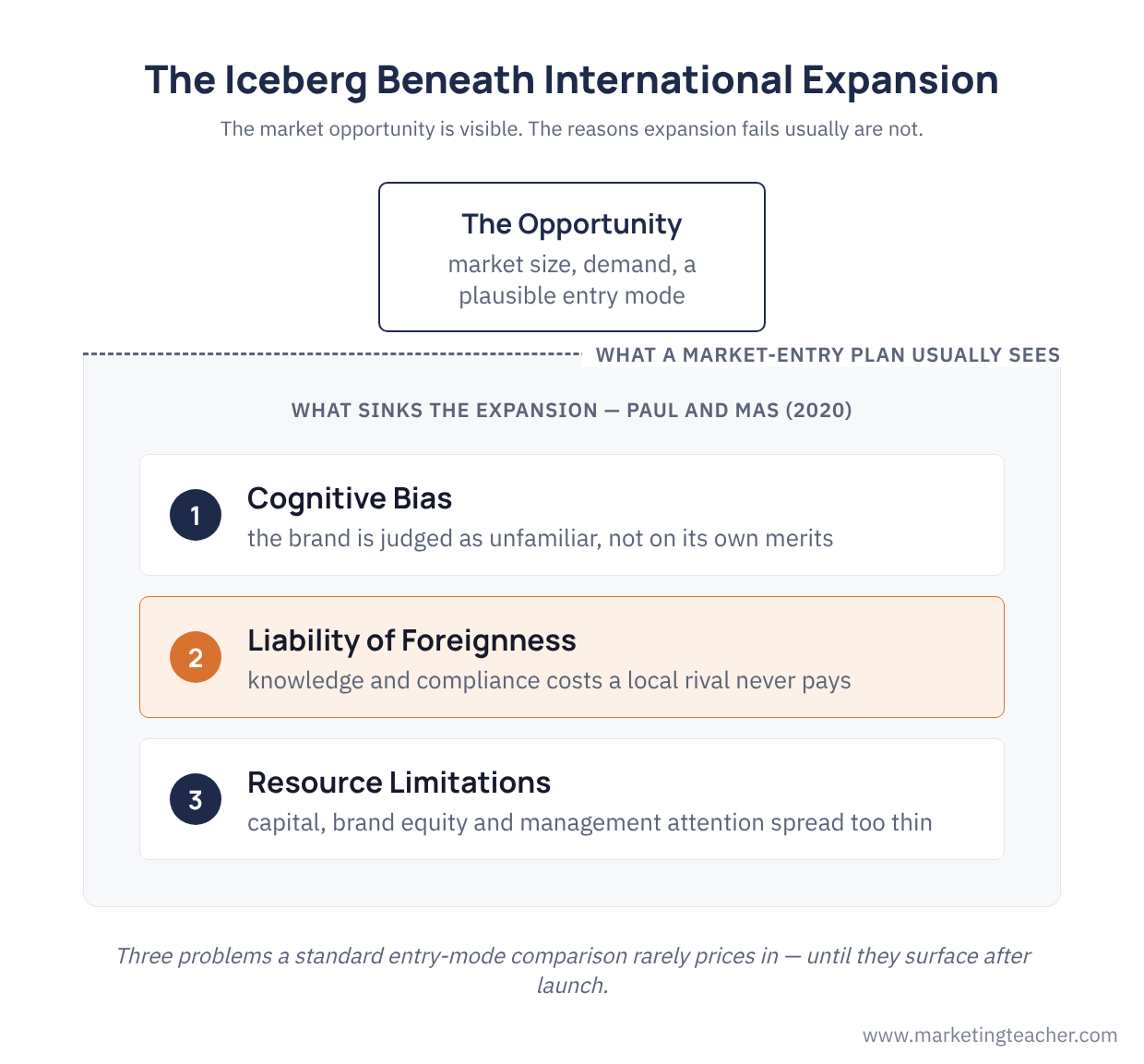
Paul and Mas (2020) group the risks of expanding abroad into three problems that recur across the firms they studied, whatever the firm’s size or home market. Cognitive bias is a mismatch between how a firm sees its own product and how a foreign customer actually perceives it — often a perception of lower quality simply because the brand is unfamiliar, which a standard international marketing plan rarely budgets for. Liability of foreignness, defined above, is the knowledge and compliance gap itself. Resource limitations are the practical constraint behind both: most firms, however large at home, arrive abroad with less capital, less brand equity and less management attention than an established local rival, and risk spreading what they do have too thin across too many new problems at once (Paul & Mas, 2020). None of the three shows up on a standard entry-mode comparison of exporting, licensing or a joint venture — they only bite once a market turns out to be further away, culturally and administratively, than the entry-mode decision assumed (see the CAGE distance framework).
The Pattern Repeats
The same three problems recur well outside fast food. Marks & Spencer opened its first Chinese store in Shanghai in 2008, then closed its last mainland stores in 2016 after the business stayed loss-making for years; one retail consultant quoted at the time concluded the retailer had misjudged what Chinese shoppers wanted from a British import, expecting aspirational luxury positioning where M&S offered its ordinary UK high-street range (Retail Gazette, 2016) — cognitive bias, in Paul and Mas’s terms, as much as liability of foreignness. Tesco’s US chain, Fresh & Easy, never reached profitability either, and was sold off in 2013 at a cost of up to £150 million after misreading what American grocery shoppers expected from a store format built around UK habits. Toyota made a similar mistake on its first push into the US in the 1950s, selling a car model quickly dismissed as underpowered for American roads — but treated the failure as one necessary step in its own stages of internationalisation rather than a reason to withdraw altogether.
Summary
International expansion fails for predictable reasons, not bad luck. Zaheer’s (1995) liability of foreignness, and Paul and Mas’s (2020) three problems of cognitive bias, liability of foreignness and resource limitations, explain why GYG, Marks & Spencer and Tesco all struggled in markets that looked, on paper, like reasonable opportunities. The practical lesson for any firm weighing up its own mode of entry is to budget for these costs explicitly before committing, grounding the decision in proper international marketing research rather than optimism, and to decide in advance what “it isn’t working” will actually look like.
The slides, worksheet, lesson plan and poster for this lesson are free to download and free to use in your course — no sign-up, no permission needed. See the teacher resources →
Assign this lesson to your class:
Using Canvas, Blackboard or Moodle? Copy the link and paste it into your course page or assignment. More ways to add lessons to your LMS.

