
What Is the CAGE Distance Framework?
The CAGE framework is a tool for judging how “far away” a foreign market really is. It was set out by Pankaj Ghemawat in the Harvard Business Review (Ghemawat, 2001). His point was simple. Managers are drawn to big markets and underrate the cost of serving them. A huge market can still be a poor choice if it is very different from your own.
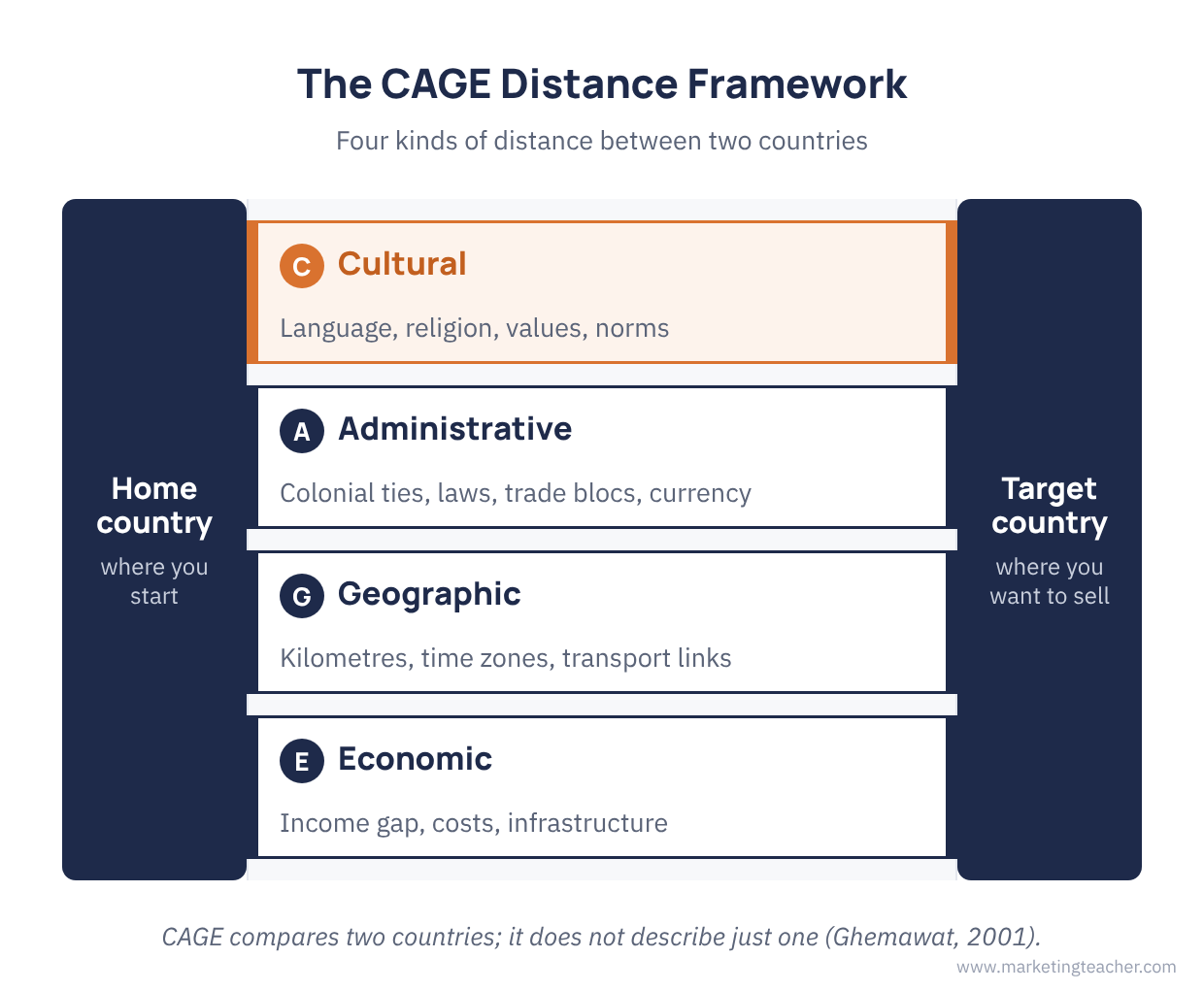
CAGE stands for four kinds of distance: Cultural, Administrative (or political), Geographic and Economic. Distance here means more than kilometres. Two countries can sit side by side on a map and still be far apart in language, law or income.
The key feature of CAGE is that it is bilateral. It always compares two countries: your home country and one target country. The same target market can be “close” for one firm and “distant” for another. Kenya looks different to a British firm than it does to a Brazilian one.
The Four Dimensions of Distance
Cultural distance comes from differences in language, religion, social norms, values and ethnic make-up. Ghemawat argues it matters most where products carry a lot of language (TV), touch on national identity (food), or are linked with a country’s reputation (wine). You can read more on this in our lesson on culture and international marketing.
Administrative distance covers the political and legal ties between countries. Shared colonial history, a common currency, membership of the same trading bloc and similar legal systems all shrink it. Hostility, sanctions and weak institutions widen it. It matters most where governments are heavily involved, such as electricity, medicines, telecoms, aerospace and mining.
Geographic distance is not just miles. It includes time zones, shared borders, access to the sea, climate and the quality of transport and communications. It matters most for heavy, low-value or perishable goods such as cement or fresh fruit, and for services that need close local supervision.
Economic distance is mainly about differences in income per head. It also covers the cost and quality of labour, finance and infrastructure. It matters most where demand changes with income (cars), where scale and standard products matter (mobile phones), or where distribution systems differ.
What Is the Evidence That Distance Still Matters?
Ghemawat built his case on gravity models of trade. These models predict that trade between two countries rises with the size of their economies and falls as distance grows. The estimates he reported are striking. A 1% increase in physical distance was linked to about 1.1% less trade. Sharing a common language was linked to about 200% more trade. A colony-coloniser link was linked to about 900% more (Ghemawat, 2001). The biggest effects are cultural and administrative, not geographic.
Later research has tested the framework on investment as well as trade. Ferreira and Falcão (2019) measured all four CAGE distances between Brazil and 55 host countries. They found that cultural and geographic distance both reduced Brazilian foreign direct investment. Economic distance had no clear effect. So not every dimension matters equally for every country or decision.
CAGE Versus PESTEL
Students often confuse CAGE with PESTEL analysis. PESTEL scans the political, economic, social, technological, environmental and legal conditions inside one country. CAGE instead measures the gap between two countries. A PESTEL tells you that a market has fast-growing internet use. CAGE tells you how hard it will be for your particular firm to serve it. The two work well together when you study the international marketing environment.
How Firms Use CAGE
CAGE is most useful early in the market entry evaluation process, when a long list of countries needs cutting down. Start with market size, then “discount” each market for its distance. A smaller, closer market can be worth more than a larger, distant one.
The framework also helps after the choice is made. Knowing which kind of distance is largest tells you what to plan for. High cultural distance points to adapting the product and promotion. High administrative distance may favour a local partner or joint venture rather than a wholly owned subsidiary. Our lesson on modes of entry looks at these options.
Limitations of the CAGE Framework
CAGE measures distance at country level. National averages hide big differences inside countries. A Nairobi graduate and a rural farmer in western Kenya are very different customers, but CAGE gives them the same score.
The four headings are also broad. Berry, Guillén and Zhou (2010) argue that distance has more parts than this. They split it into nine dimensions, including financial, demographic and knowledge distance, and found that the separate measures explained US firms’ foreign expansion better than a single cultural measure.
Finally, digital trade is shrinking geographic distance. Lendle et al. (2016) found that the effect of distance on trade was 65% smaller on eBay than on trade overall, mainly because online search makes it cheaper to find sellers abroad. For online firms, time zones and payment systems may matter more than kilometres.
Summary
The CAGE framework compares a home country with a target country on four kinds of distance: cultural, administrative, geographic and economic. Unlike PESTEL, which looks at one country, CAGE is bilateral, so the same market can be near for one firm and far for another. Trade evidence shows that shared language and political ties matter a great deal, often more than kilometres. Firms use CAGE to shortlist markets and to decide what to adapt and how to enter. Its weaknesses are that country averages hide local differences, four headings are broad, and digital channels reduce the weight of physical distance.
The slides, worksheet, lesson plan and poster for this lesson are free to download and free to use in your course — no sign-up, no permission needed. See the teacher resources →
Assign this lesson to your class:
Using Canvas, Blackboard or Moodle? Copy the link and paste it into your course page or assignment. More ways to add lessons to your LMS.

