
Learning Outcome: By the end of this lesson, you will be able to explain what drives engagement with visual content on Instagram, compare the platform’s main content formats, and apply the research to plan a realistic content strategy.
This lesson is part of our Foundations of Social Media Marketing course. Study the full course and earn a certificate →
Why Is Instagram Different From a Text-First Platform?
Instagram is built around the image and video first, with captions playing a supporting role rather than the reverse. Rietveld et al. (2020), writing in the Journal of Interactive Marketing, analysed 46,900 Instagram posts from 59 brands across six sectors using machine learning to extract the emotional and informative content of each image, and found that the visual content itself – not just the caption – measurably drives likes and comments. Specifically, images with high positive emotional arousal, and images with low negative arousal, both increased engagement, while purely informative visuals only helped when the information was directly brand-related. The clear implication is that what an image looks and feels like matters as much as what it says.
Comparing the Main Content Formats
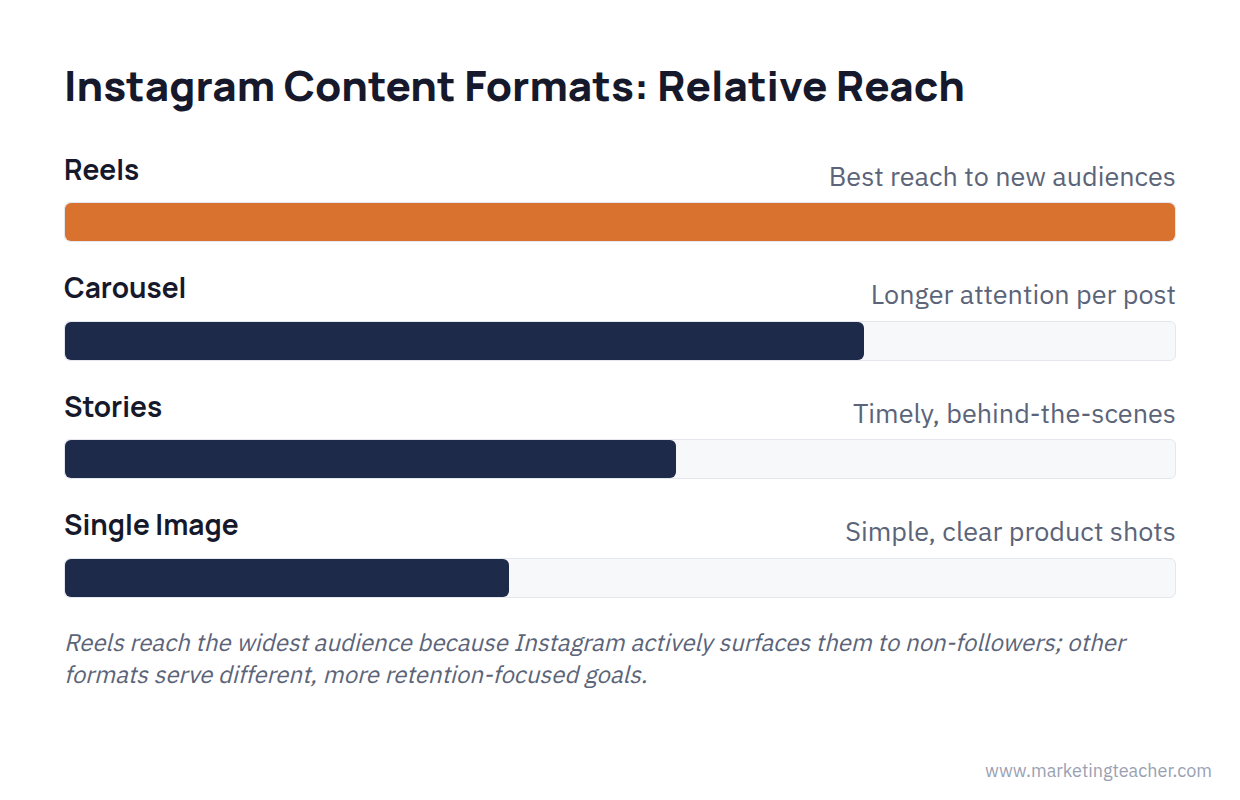
Instagram now offers several distinct formats, and they don’t perform identically. A single static image remains the simplest format and works well for clear product shots. A carousel (multiple images swiped through in one post) tends to hold attention longer, since a viewer who engages with the first image is more likely to continue. Reels, Instagram’s short-form video format, generally reach further than static posts because the platform’s discovery feed actively surfaces them to non-followers, making them the strongest format for reaching new audiences rather than only existing followers. Stories, which disappear after 24 hours, suit timely or behind-the-scenes content that doesn’t need to live on a profile permanently.
Authenticity Over Polish
A recurring finding across recent Instagram research is that heavily produced, obviously staged content is losing ground to visuals that feel authentic and unfiltered. This shift has pushed many brands away from studio photography and toward user-generated content, behind-the-scenes footage, and creator partnerships that read as genuine rather than scripted. This doesn’t mean quality no longer matters, but that the specific kind of quality being rewarded has changed – from polish to perceived honesty.
Example: Thackeray Skincare Tests Two Content Styles
The fictional skincare brand Thackeray Skincare ran two parallel content approaches on its Instagram for a single month: professionally shot product photography on a plain background, and short, unpolished clips of real customers applying the product at home, filmed on a phone. The user-style clips generated roughly two and a half times more comments than the studio shots, despite Thackeray spending far less to produce them. Save rates – a strong signal of genuine future purchase intent, since a user is bookmarking the post to return to it – were also higher on the informal clips. Thackeray shifted the bulk of its content budget toward creator partnerships rather than studio production the following quarter.
Hashtags and Discoverability
Hashtags remain a real discovery mechanism on Instagram, but their effectiveness depends on relevance rather than volume – a small number of specific, genuinely related hashtags tends to outperform a long list of broad, popular ones, since the platform’s own recommendation system increasingly surfaces content based on its actual visual and behavioural signals rather than tag-matching alone.
Working With Influencers and Creators
Instagram remains one of the most established platforms for influencer marketing, and the underlying mechanism is worth understanding rather than treating as simple celebrity endorsement. Argyris et al. (2020), analysing over 45,000 images using deep-learning classification in Computers in Human Behavior, proposed a “visual-congruence-induced social influence” framework showing that engagement rises when an influencer’s own visual style and interests genuinely align with a brand’s, rather than when reach or follower count alone are used to select a partner. This means a smaller creator whose aesthetic closely matches a brand can often outperform a larger one who doesn’t, at a fraction of the cost.
Where This Fits in a Wider Strategy
Instagram works best as a mid-to-lower funnel platform: it’s rarely where a brand introduces itself entirely cold, but it excels at building an emotional connection with an audience that has some existing awareness, and at showcasing a product’s use in a way a plain product description cannot. Its shopping features also let a business move a browsing user directly toward a purchase without leaving the app.
Instagram Shopping and the Final Step
Instagram’s shopping tools – product tags on posts, a dedicated shop tab, and in-app checkout in supported markets – let a business collapse the distance between inspiration and purchase to almost nothing. This matters because Instagram’s core strength has always been emotional, visual engagement rather than direct-response advertising, and shopping features let a brand capture the purchase intent that engagement creates before a browsing user has time to lose interest or forget which product caught their eye in the first place.
Summary
Engagement on Instagram is driven by the visual and emotional content of an image or video itself, not only by caption text, and different formats – static posts, carousels, Reels, and Stories – serve different goals within a strategy. The platform currently rewards content that feels authentic over content that feels produced, and works best as a way to deepen a connection with an audience rather than introduce a brand from zero.
Key Idea: On Instagram, what an image feels like matters as much as what it shows – research consistently finds that the emotional quality of a visual, not just its production value, is what actually predicts whether people engage with it.
More in this series: Marketing on the social platforms
Facebook Marketing · Instagram Marketing · Twitter Marketing · TikTok Marketing · Snapchat Marketing · Influencer Marketing · Social Networks
Teaching this topic?
The slides, worksheet, lesson plan and poster for this lesson are free to download and free to use in your course — no sign-up, no permission needed. See the teacher resources →
Assign this lesson to your class:
Using Canvas, Blackboard or Moodle? Copy the link and paste it into your course page or assignment. More ways to add lessons to your LMS.
Written by Marketing Teacher.
Online course · certificate on completion
Study the full Social Media Marketing course — and earn a certificate
Eleven modules on strategy, content, community, advertising and measurement, written at Level 4, with a short quiz after each.

