
What Makes Snapchat Marketing Different?
Snapchat’s defining feature is content that disappears — a Snap sent to a friend or posted to a Story is, by design, temporary rather than a permanent addition to a feed. Marketing built around ephemeral content behaves differently from marketing built around a permanent post: a Snap can feel more like a real-time moment worth catching than a polished asset worth studying, which tends to reward spontaneity and quick reaction over heavily produced content. A 2025 peer-reviewed study on ephemeral content marketing found that this temporary, moment-driven quality is specifically linked to stronger feelings of brand closeness and engagement compared with permanent content, precisely because it feels more authentic and less staged (Nguyen et al., 2026).
The Main Tactics Brands Actually Use
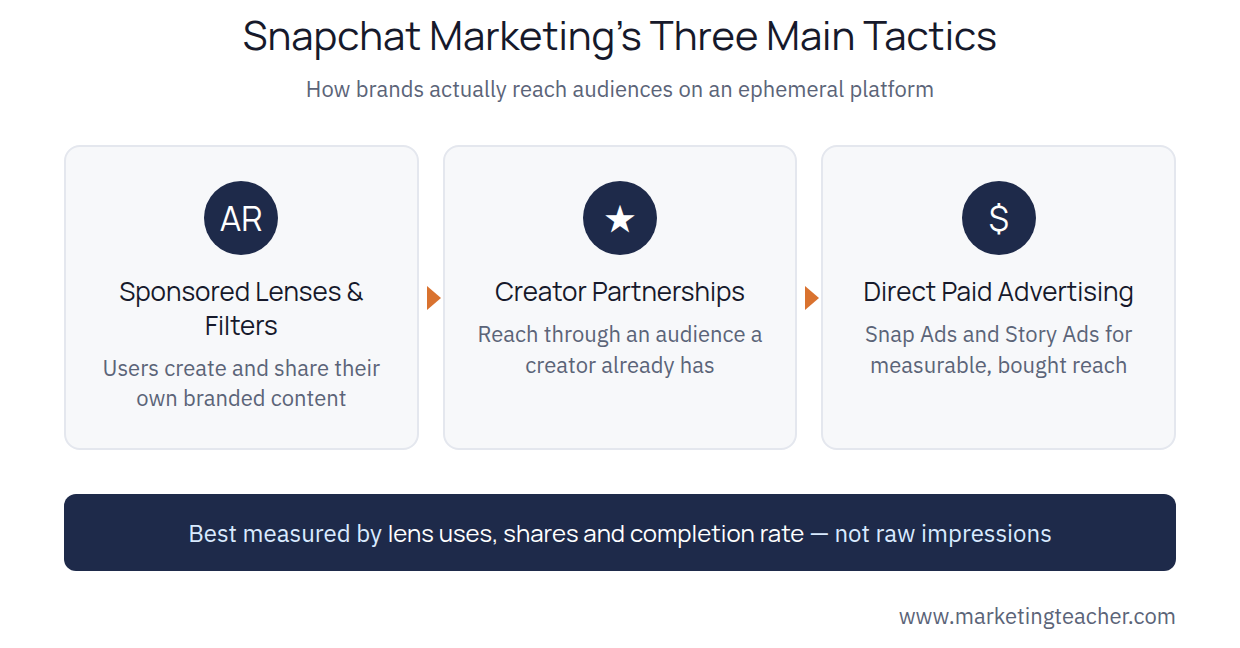
Three tactics account for most brand activity on the platform. Sponsored AR lenses and filters let users add a branded effect to their own Snaps, turning the brand into part of a piece of content the user chooses to create and share themselves rather than an ad they simply view. Influencer and creator partnerships put a product or campaign in front of an audience through someone the audience already follows, which matters especially on a platform where organic brand accounts don’t reach a wide audience the way a popular creator’s Stories do. Direct paid advertising — Snap Ads and Story Ads that run between users’ own content — remains the most straightforward way to buy specific reach and measure results against a campaign goal.
Who Snapchat Actually Reaches
Snapchat’s audience skews younger than most general-purpose social platforms, and the platform’s own investor disclosures continue to report a large, engaged daily user base concentrated in that demographic (Snap Inc. investor relations, 2026). For a brand whose target customer is genuinely in that younger age range, this makes Snapchat a platform worth a dedicated strategy rather than an afterthought version of a campaign built for another platform first. For a brand targeting an older demographic, Snapchat is usually a poor primary fit, whatever a general “social media presence” checklist might suggest — the platform’s specific strength is reaching an audience other platforms increasingly struggle to.
Why Ephemeral Content Needs a Different Content Plan
A content calendar built for a permanent-post platform doesn’t translate directly to Snapchat, because content that vanishes rewards a much higher volume of smaller, quicker pieces rather than a handful of heavily polished posts. A brand that tries to run Snapchat with the same monthly content-approval process it uses for a permanent feed will typically find the content feels stale by the time it’s approved and posted — ephemeral platforms favour a lighter, faster approval process specifically so the content can still feel current and spontaneous when it goes out. In practice this often means pre-approving a style and a set of topics a small team can act on quickly, rather than routing every individual Snap through the same sign-off a brand would use for a permanent billboard or a long-running social post.
What’s Worth Measuring
Because so much of Snapchat’s value comes from content users choose to create and share themselves, view count alone understates a campaign’s real reach. Lens or filter uses, shares, and screenshot counts are usually better indicators of genuine engagement than impressions, since they show a user actively choosing to interact with and pass on the branded content rather than simply having it appear in front of them. Completion rate on Story Ads (how many viewers watch to the end rather than swiping past) is also a more useful signal than raw view count for judging whether the creative itself is holding attention, and it’s worth tracking separately from reach metrics rather than folding it into one blended engagement score.
Summary
Snapchat marketing is built around content that disappears rather than persists, which research links to stronger feelings of brand engagement precisely because it feels more spontaneous and authentic than permanent content (Nguyen et al., 2026). Brands reach audiences mainly through sponsored AR lenses and filters, influencer and creator partnerships, and direct paid advertising, and the platform’s own reported user base remains concentrated among younger users (Snap Inc. investor relations, 2026) — making it a strong fit for brands targeting that group and a weak one for brands that aren’t. Because ephemeral content rewards speed and spontaneity over heavy production, a Snapchat content plan usually needs a faster, lighter approval process than a brand’s other social channels.
The slides, worksheet, lesson plan and poster for this lesson are free to download and free to use in your course — no sign-up, no permission needed. See the teacher resources →
Assign this lesson to your class:
Using Canvas, Blackboard or Moodle? Copy the link and paste it into your course page or assignment. More ways to add lessons to your LMS.

