
What Is the Internet of Things, in a Marketing Context?
The Internet of Things (IoT) describes a world in which everyday products — appliances, vehicles, wearables, even clothing — are digitally connected to each other and to the internet, constantly sending and receiving data (Kotler and Armstrong, 2018). For marketers, IoT matters less as a technology story and more as a data story: a connected product doesn’t stop being useful to a marketing team once it’s sold, because it keeps reporting back how it’s actually being used.
From One-Time Sale to Ongoing Relationship
Kotler and Armstrong (2018) illustrate this shift through Samsung’s push into IoT-connected appliances and devices, built around the idea that products should stay “in sync” with the people using them rather than functioning in isolation. A traditional appliance sale ends at the checkout; a connected one keeps generating a stream of usage data — how often it’s used, how it’s used, when it fails — that a marketing team can act on long after the purchase. That turns a single transaction into the start of an ongoing relationship, with real data behind it instead of a guess about what happened after the sale.
What a Connected Product Actually Tells a Marketer
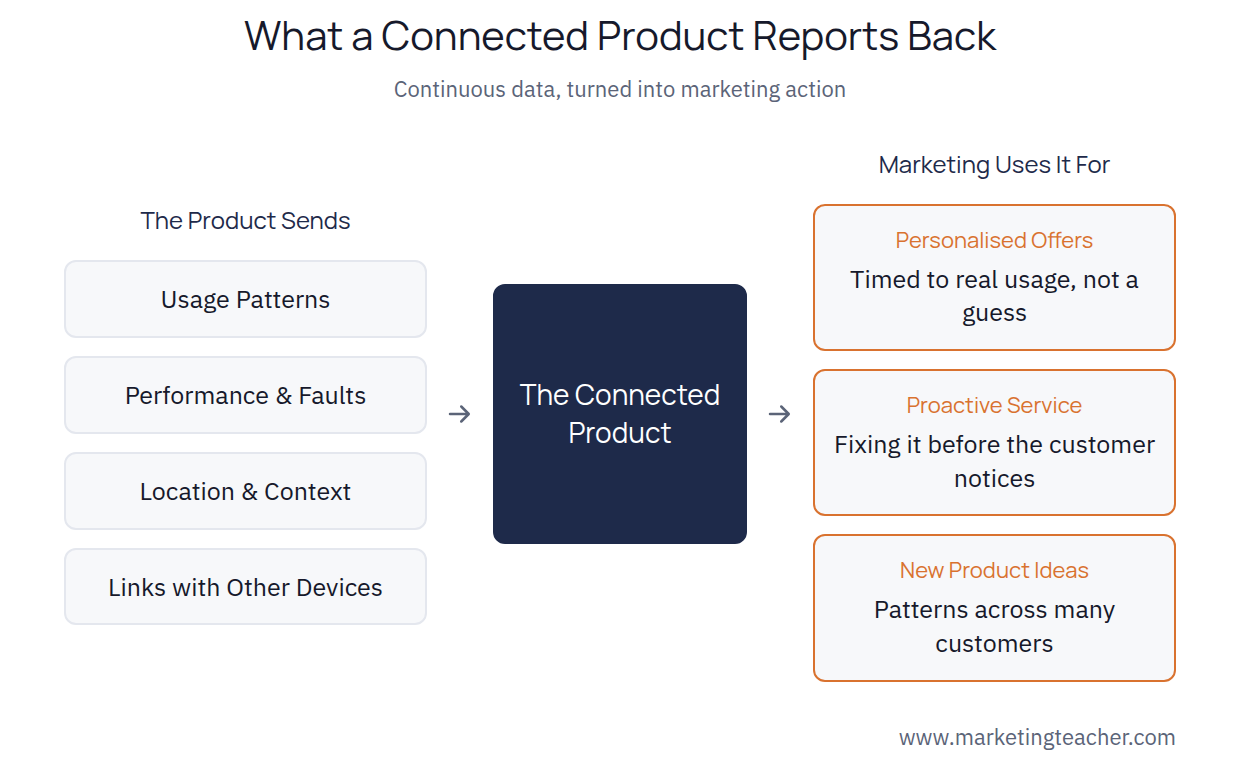
A connected product typically reports back on a handful of things: how often and how it’s actually being used, early signs of performance problems or faults, where and in what context it’s being used, and how it interacts with other devices in the same household or business. None of that data is useful on its own — its value comes from what a business does with it. Usage patterns can drive personalised offers timed to when a customer is actually likely to need something. Fault signals can trigger proactive service before a customer even notices a problem. And patterns across many customers can surface genuine new product ideas that would never have shown up in a traditional customer survey.
The Trust Question Connected Products Raise
A product that reports continuously on how it’s used is also a product that raises a fair question: who sees that data, and what else is it used for? Customers who are comfortable with a smart thermostat learning their schedule may feel differently about a car tracking their driving habits for insurance purposes, or a fitness tracker’s data being sold to a third party. Kotler and Armstrong (2018) note this is part of a broader environment in which everything and everyone becomes digitally connected — and marketers working with IoT data carry a responsibility that traditional purchase-history data didn’t: being clear about what’s collected, giving customers a genuine way to opt out, and never treating “the data exists” as the same thing as “we’re entitled to use it however we like.”
Where This Fits Alongside Other Data-Driven Marketing
IoT data doesn’t replace the other sources a marketing team already draws on — it adds a layer that’s live and behavioural rather than self-reported. Combined with the kind of underlying customer profile built through CRM and Big Data, connected-product data lets a business move from knowing what a customer bought to knowing how they’re actually using it, which is a meaningfully richer basis for the next offer, service touchpoint or product decision.
It’s Not Only a Consumer Story
The same logic applies just as strongly in business-to-business marketing, often with even clearer payoffs. A manufacturer selling connected industrial equipment can monitor a machine’s real-world performance at a customer site, flag maintenance needs before a costly breakdown, and use verified uptime and efficiency data as concrete evidence in the next contract renewal conversation — replacing a sales pitch built on claims with one built on the customer’s own operating record. For B2B marketers in particular, this turns account management from a relationship maintained through periodic check-ins into one supported by a continuous, factual view of how the product is actually performing for that specific customer.
Summary
The Internet of Things connects everyday products to the internet and to each other, and for marketers that means a product keeps reporting useful data long after it’s sold — usage patterns, performance signals, location and context. Businesses use that stream to personalise offers, deliver proactive service, and surface genuine new product ideas, turning what used to be a one-time sale into an ongoing relationship. The same continuous data collection raises real questions about privacy and consent, and a marketing team that treats those questions seriously protects the trust that makes the whole relationship worth having in the first place.
The slides, worksheet, lesson plan and poster for this lesson are free to download and free to use in your course — no sign-up, no permission needed. See the teacher resources →
Assign this lesson to your class:
Using Canvas, Blackboard or Moodle? Copy the link and paste it into your course page or assignment. More ways to add lessons to your LMS.

